Get Full Government Meeting Transcripts, Videos, & Alerts Forever!
Get email alerts on the Municipal Utility topic
No spam. Unsubscribe anytime.
Coachella approves development agreement to build municipal electric utility serving data‑center campus
Summary
The Coachella City Council on Feb. 11 approved a development agreement with Coachella Valley Power Services LLC (Stronghold affiliate) to launch a city‑owned municipal electric utility serving an initial technology campus in the city’s eastern undeveloped area. Council members discussed financing, market risk and interconnection with IID before a unanimous vote.
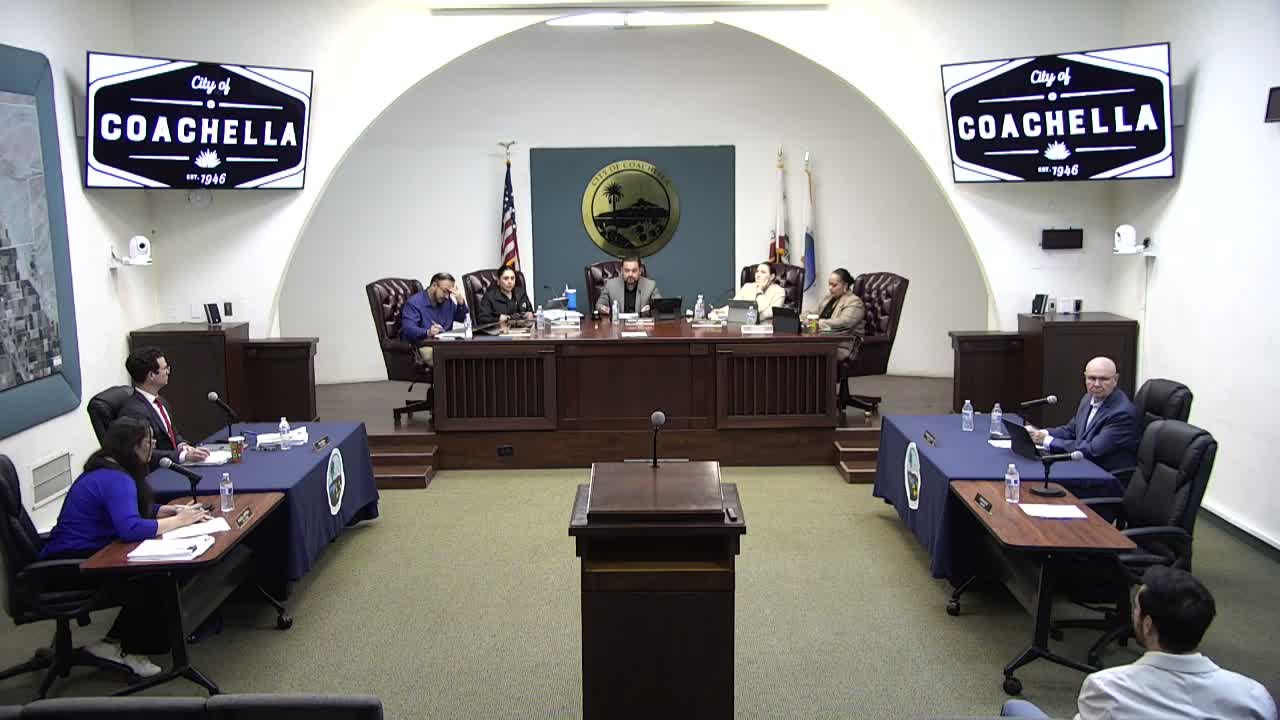
The Coachella City Council voted Feb. 11 to approve a comprehensive development agreement with Coachella Valley Power Services LLC, an affiliate of Stronghold Power Systems, to create the Coachella Municipal Utility (CMU) and build an initial technology campus to serve large data centers in the city’s eastern undeveloped area.
City Attorney Ryan Barron told the council the agreement covers Phase 1 of a turnkey public‑private partnership under which the city will remain the publicly owned utility while Stronghold and its affiliate will design, permit, finance, construct and operate core electrical infrastructure. "Under the development agreement, the city is the independent publicly owned utility, you know, what we call the Coachella Municipal Utility or CMU," Barron said.
Why it matters: council members said the project could give Coachella greater local control over electricity, provide new revenue streams and support economic growth around a planned technology campus. Stronghold described a phased build that would first serve a roughly 240‑acre campus intended for multiple data center buildings. Barron described a minimum capacity figure presented in the staff materials and Stronghold representatives described off‑take needs in the same discussion: the presentation referenced a 240‑acre campus with a development estimate described as a minimum in the materials and Stronghold said the utility could provide up to about 300 megawatts to the data centers.
Stronghold representatives said the turnkey provider will assume significant development and market risk. Jonathan Avila, business operations director for Stronghold, described the staged buildout and design elements including microgrids and an energy center. Stronghold CEO Scott Bailey told the council the company expected the utility arrangement to return revenue to the city; "The utility itself, you know, is basically producing 8% of gross revenues that are coming back to the city," Bailey said.
Council members repeatedly pressed staff on city exposure and risk. A staff attorney and the private‑partner representatives said the agreement includes indemnity provisions and that Stronghold will arrange the project financing, hedging and long‑term procurement agreements intended to reduce market‑price exposure. As the attorney explained, operational market risk would largely be managed through Stronghold’s procurement strategy and the city would retain rate‑setting authority: decisions about retail rates and rules would return to council review.
Interconnection and regional coordination also featured in the discussion. Staff said the municipal utility will serve the eastern portions of the city while Imperial Irrigation District (IID) remains the transmission owner for adjacent areas; Stronghold noted IID’s recent tariff changes and a network‑integrated transmission approach they are following. The presenters said they are pursuing transmission applications with IID and that a Joint Powers Agreement (JPA) approach with IID would be considered for service in other parts of the city.
The council voted to approve staff’s recommendation. The motion to approve the development agreement passed on a roll call following the presentation and questions.
What’s next: staff and Stronghold will proceed through the agreement’s conditions precedent, environmental review and permitting steps, with a target schedule described in the presentation that included core infrastructure work starting after entitlements and construction completion of phase 1 targeted in the materials for 2029. Future council decisions will include specific entitlements, rate proposals and formation steps required to put the CMU into operation.