Get Full Government Meeting Transcripts, Videos, & Alerts Forever!
Get email alerts on the Public Safety topic
No spam. Unsubscribe anytime.
Coachella council hears proposal for two-officer motor team and 14-camera license-plate reader pilot
Summary
Councilmembers were presented with two public-safety options — a two-person motorcycle enforcement team and a 14-camera automated license-plate reader (ALPR) system — and asked staff to show budget impacts and return with more details and community outreach.
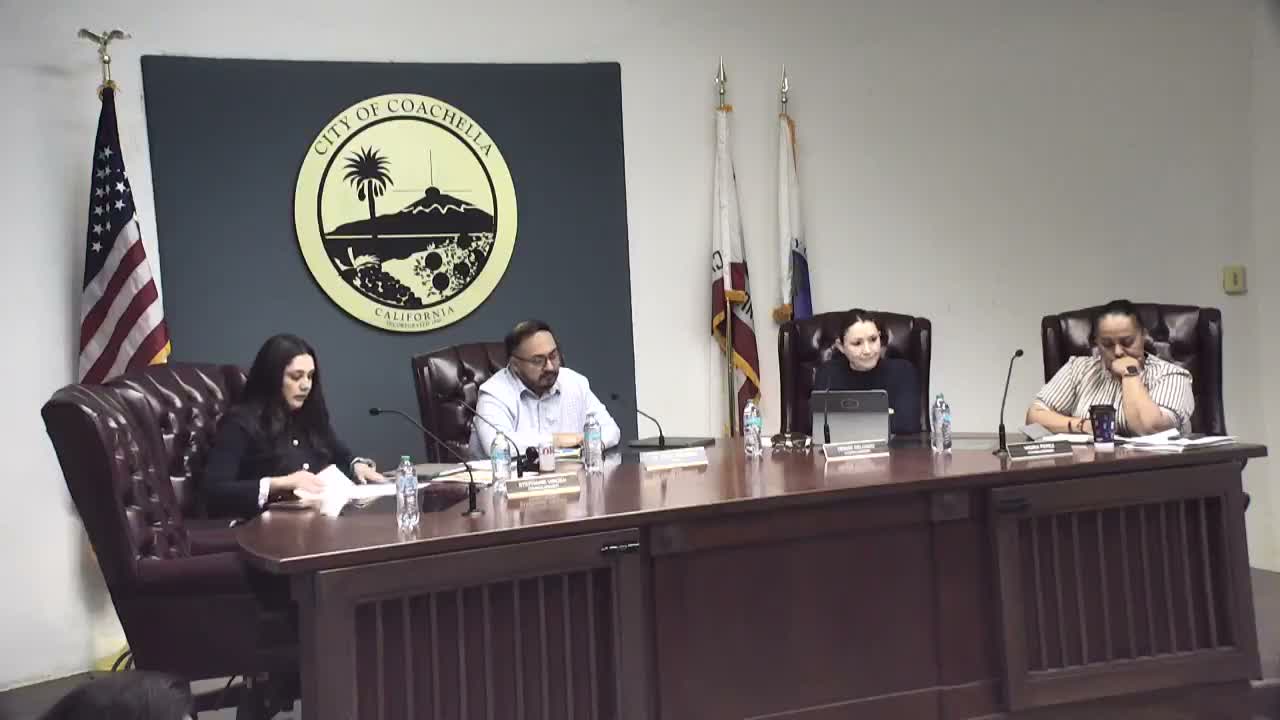
Mayor Figueroa and the City Council heard presentations May 5 on two public-safety proposals the city could add to the FY 2026–27 budget: creating a two-officer motor traffic-enforcement team and piloting an automated license-plate reader system.
Finance Director Lincoln Bogart opened the study session and framed the proposals as options for council direction rather than items for immediate approval. The motor-team proposal was presented by Corporal Tim Garfin of the Riverside County Sheriff’s Office, who said Coachella currently has no dedicated motorcycle officers and that comparative data show neighboring contract cities run far more proactive traffic enforcement.
"So our recommendation is to establish a 2 person motor team," Garfin said, outlining a plan to convert the existing traffic deputy position into a motor position and add one additional motor deputy. He told council the startup cost for two motorcycles and equipment is roughly $111,000 and estimated an annual operating cost increase of about $400,000–$500,000 depending on staffing and contract terms.
Garfin argued motor units yield faster response times and higher enforcement visibility, citing data comparing citation frequency and collision rates with nearby cities. Council members praised the safety rationale but asked staff to analyze budget impacts, hours of operation (motors are typically not used at night for safety reasons) and how the change would align with the city’s existing five-year staffing plan.
On the ALPR proposal, a sheriff’s sergeant described a Flock Safety automated license-plate reader network that captures plate strings and vehicle descriptors to help locate stolen cars and missing persons. The presenter said the recommended configuration included 14 cameras, an initial purchase cost of about $49,000 and an annual subscription of about $49,000 for software, maintenance and support. He said the suggested initial purchase could be funded from asset-forfeiture funds, with subscription costs placed into future operating budgets.
The presenter emphasized privacy safeguards, auditing and the limits placed by California Senate Bill 34 on interjurisdictional data sharing. "Data retention is controlled and managed according to law, policy and retention requirements," the presenter said, describing audit logs and command-level release procedures.
Council members expressed interest in the crime-fighting and missing-person benefits but raised legal and privacy concerns. One member noted a recent lawsuit in San Jose involving ALPR use and recommended a cautious approach. Several council members asked staff to return with a budget impact analysis, a proposed pilot period, vendor contract details and community outreach materials.
City staff said they would bring both programs back to the public-safety committee and work with the sheriff’s office to model costs and operational impacts ahead of the June budget adoption timeline.
The study session continued with additional budget and operations items; no action was taken on either public-safety proposal during the meeting.