Get Full Government Meeting Transcripts, Videos, & Alerts Forever!
Get email alerts on the Sustainability topic
No spam. Unsubscribe anytime.
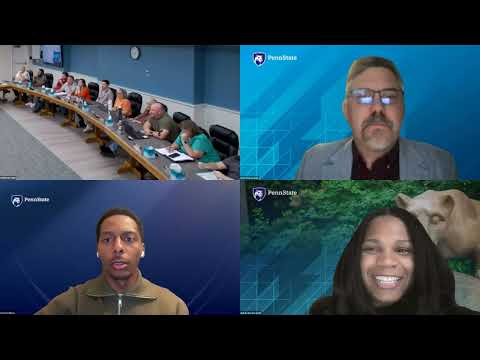
Penn State LCAP students present anti‑idling, composting and solar work plan to Indiana Borough Council
Summary
Penn State Local Climate Action Program students outlined a summer intern‑led work plan that pairs anti‑idling education, a paused composting feasibility effort and renewable‑energy outreach to reduce emissions and build community capacity.
Deondre Hutton and Mikaela Wilson Smith of Penn State’s Local Climate Action Program (LCAP) presented a student‑driven sustainability work plan to the Indiana Borough Council, describing how a short internship could pilot anti‑idling observations, prepare composting feasibility materials and expand renewable‑energy outreach.
Hutton framed the approach around ClearPath 2 forecasting: establish a baseline emissions inventory, set sector targets and model specific strategies, he said, so the borough can compare projected outcomes and adjust policies. “Forecasting gives us a way to move from understanding current emissions to making informed decisions and measuring long‑term progress,” Hutton said.
The students proposed three integrated initiatives: an anti‑idling campaign targeting school pickup zones and busy streets; laying groundwork for a community composting program; and renewable‑energy education, including workshops, fact sheets and a public resource hub. Smith said the team had prepared an application for a Pennsylvania Recycling Technical Assistance grant that would have provided $7,500 in free consulting for a composting feasibility study, but the group chose to pause submission and instead develop a summer intern work plan to advance readiness and data collection.
During questions, council members pressed for quantification of benefits. Hutton and Smith said anti‑idling measures are relatively low‑cost but individually modest in emissions reductions; they cited U.S. Department of Energy guidance that idling contributes a few percentage points to transportation emissions overall. The presenters also stated that local idling, as measured in their borough inventory, can represent a more substantial share of local emissions (they described it as about 15% of total borough emissions) and offered to provide more detailed estimates on request, noting that modeling depends heavily on data inputs and assumptions.
On renewable energy, Smith said the group’s rooftop solar scenario modeled maximum potential generation and did not incorporate full end‑of‑life recycling or replacement waste in the initial forecast. “We do not believe it took into account the end of life,” Smith said, but the team offered to estimate lifecycle and recycling impacts for council follow‑up.
The students recommended an 8–12 week summer internship or fellowship to pilot baseline observations, develop outreach materials and collect the data needed to make grant applications and program decisions. Expected outcomes cited by the presenters included higher recycling diversion rates, modest near‑term emission reductions from behavior change, improved local energy literacy and stronger town‑university partnerships for long‑term climate planning.
Council members thanked the presenters and said staff would follow up to discuss next steps. The presentation closed with an offer from the students to provide more detailed projections and implementation estimates on request.