Get Full Government Meeting Transcripts, Videos, & Alerts Forever!
Get email alerts on the School Facilities topic
No spam. Unsubscribe anytime.
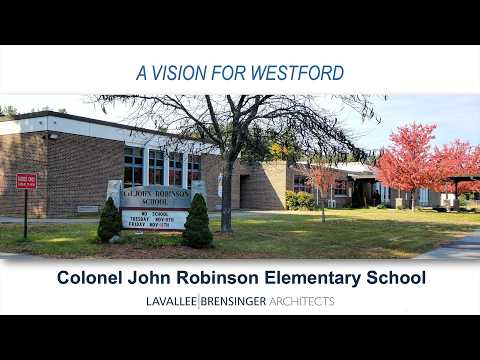
Westford forum lays out MSBA‑backed feasibility study for Robinson School; sustainability and consolidation options highlighted
Summary
Designers and Westford Public Schools officials presented a feasibility study for Robinson School, detailing three enrollment scenarios, MSBA reimbursement rules (48% base, possible bonus points), estimated repair backlogs and a set of sustainability goals tied to potential additional funding and federal/state incentives. Public questions focused on resilience, solar procurement and battery safety.
At a community forum, Westford Public Schools and the project design team walked residents through a MSBA‑sponsored feasibility study for Robinson School, presenting three enrollment scenarios, repair‑cost estimates for the district’s oldest elementary buildings and a package of sustainability goals intended to maximize MSBA reimbursement and outside incentives.
The district’s presentation noted that a 2023 district facilities assessment identified Robinson as having the greatest capital‑repair needs; the assessment listed repair backlogs of about $9.7 million for Robinson, $8.2 million for Abbott and roughly $10.5 million for the Day School, figures the presenters said reflect repairs only, not improvements or expansion costs. The Massachusetts School Building Authority (MSBA) has accepted the district into its process and has committed to reimbursing 48% of eligible costs as a baseline, presenters said.
Design and project‑management leads described three enrollment/configuration choices that will drive the preferred project: a 470‑student option (pre‑K–2), a 705‑student pre‑K–5 option that could consolidate Robinson and Abbott, and a 1,065‑student pre‑K–5 option that could consolidate Robinson, Abbott and the Day School. The presenters stressed the school committee must approve the educational plan; the district said the school committee will vote on the education plan on June 15 and is scheduled to review enrollment options in the fall, with a recommended preferred schematic due from the Robinson School Building Committee on Dec. 1 and MSBA board review aimed for February 2027.
The sustainability portion of the presentation, led by Jenny Kadiamaki of the architect team, outlined the MSBA baseline sustainability requirements (LEED Silver certification, enhanced commissioning and compliance with the Massachusetts stretch energy code) and potential incentive programs. "LEED Silver is kind of the lowest level," Kadiamaki said; she added that projects often earn higher LEED levels and that MSBA offers additional reimbursement points for meeting specialized code and indoor‑air quality criteria that can boost the base reimbursement.
Speakers identified three main incentive sources to evaluate alongside MSBA reimbursement: MSBA bonus points (which Kadiamaki said could raise eligible reimbursement above the 48% base if the project earns extra points), federal incentives under the Inflation Reduction Act for measures such as geothermal wells or high‑efficiency heat pumps, and state utility incentives (Mass Save) for energy‑efficiency measures. The presenters clarified that on‑site photovoltaic systems will be designed for solar readiness (conduit, structural capacity and electrical panels with space for PV equipment), but that rooftop PV procurement and the timing of installation are financing decisions separate from MSBA reimbursement. A resident asked whether the MSBA covers solar panels; the presenters answered that solar panel installations are not covered as part of the MSBA eligible‑cost reimbursement.
Residents raised resilience and safety issues: presenters said they will study generator options ranging from limited life‑safety systems to larger backup capacity and will coordinate with town emergency planners. An audience member warned of community pushback around battery storage and thermal‑runaway risks at sites that include children; the speaker said siting, mitigation and clear safety planning would be required if battery storage is considered.
Project team members described technical energy goals — targeting a substantial reduction in energy‑use intensity compared with typical Massachusetts school buildings through a high‑performance envelope, energy‑recovery systems and options such as ground‑source heat pumps — and said they will perform life‑cycle cost analyses so the school building committee can weigh upfront costs against long‑term savings.
The forum closed with reminders about public engagement: the team plans seven community meetings during the feasibility phase, a project website and an email contact for questions, and the next meeting will focus on the traffic study and site circulation. Presenters named the owner’s project manager (Vertex) and said design work is led by the architect team (Lavalley Brensinger and representatives introduced by the district).