Get Full Government Meeting Transcripts, Videos, & Alerts Forever!
Get email alerts on the Cannabis Enforcement topic
No spam. Unsubscribe anytime.
Committee advances ordinance adopting state civil enforcement powers against unlicensed cannabis sales
Summary
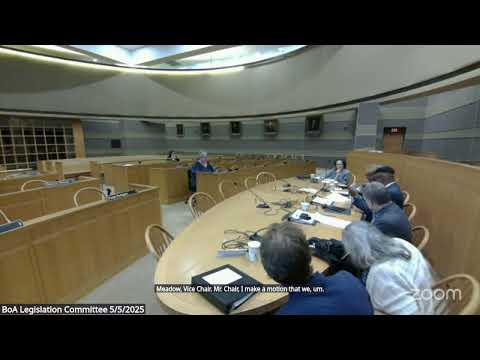
The committee voted to forward an amended ordinance that would adopt Connecticut's civil enforcement and penalty provisions for unlicensed cannabis sales into the municipal code, adding seizure and civil‑fine authority and directing city staff to coordinate with state agencies.
The New Haven Legislation Committee voted to forward an amended ordinance that would incorporate Connecticut General Statute 21a‑420c's civil enforcement and penalty provisions into city law, aiming to give municipal officials new tools to shut down and levy civil fines against unlicensed cannabis sellers.
Assistant Corporation Counsel Michael Pinto told the committee the draft was adjusted after conversations with the Attorney General's office and state regulators, and that the city's version would allow municipal civil enforcement, including seizure and, if state law provides it in the near future, shutter orders. "The civil fines of $30,000 sound like a lot," Pinto said, "but when you talk to DCP they describe businesses doing far more per day, so these fines are part of the enforcement toolbox."
Counsel explained process mechanics: a city enforcement agent would document violations, the mayor (or a designated official) could apply to superior court for seizure orders, and seized merchandise would be handled under police evidence procedures. The ordinance as amended references the state statute "in its entirety" so the city would not need to enumerate every separate technical requirement (packaging, labeling, security) in the municipal language.
Committee members debated who should administratively manage enforcement: the economic development administrator (EDA), the mayor (or designee), or the health director. Counsel said the EDA was recommended because it already houses zoning and building enforcement processes; members pressed for clarity to ensure public‑health inspectors and police could initiate reports that feed into the enforcement sequence.
After discussion and several technical amendments by substitution, the committee gave the ordinance a favorable recommendation to the full board. Committee members framed the change as a response to the proliferation of unlicensed smoke shops and illicit products marketed to minors; several members urged public education and interagency coordination as follow‑up steps.
The ordinance will go to the full board for final consideration.