Get Full Government Meeting Transcripts, Videos, & Alerts Forever!
Get email alerts on the Treatment Court topic
No spam. Unsubscribe anytime.
Treatment court coordinator urges community support, council approves proclamation
Summary
Alyssa Hackenmueller, Border Treatment Court coordinator, described the court's focus on individualized treatment and 'recovery capital,' asked the community to help form a 501(c)(3) to provide small supports, and announced a stakeholder meeting; the council approved a proclamation recognizing National Treatment Court Month.
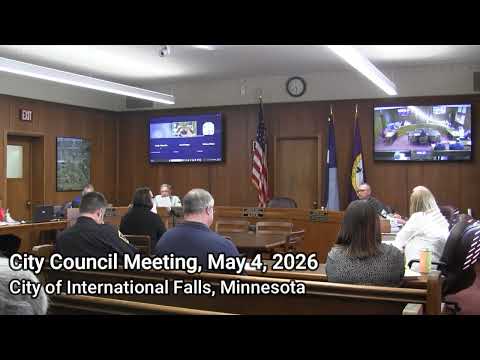
Alyssa Hackenmueller, the Border Treatment Court coordinator, told the International Falls City Council on May 4 that the court provides individualized treatment combined with close supervision and community supports and urged local leaders to help form an outside nonprofit to fund small but important recovery activities.
"Number 1, treatment courts offer individualized treatment. Number 2, it's a high level of accountability," Hackenmueller said, summarizing the program model. She described "recovery capital" as the financial, tangible and social resources—housing, transportation, employment and sober supports—that help people sustain long-term recovery.
Hackenmueller said her staffing team cannot solicit donations because of judicial-branch restrictions and that forming a separate 501(c)(3) would allow the community to raise modest funds for items such as sports equipment or activity fees. "I can't even as the coordinator or an employee of the judicial branch solicit funding for donations," she said, adding that her team would serve as a liaison while an outside entity holds funds and makes grants.
She said the court enrolls people who meet two core criteria: (1) they face a gross misdemeanor, felony or probation-violation charge, and (2) they are assessed as high risk to reoffend; admission also requires a clinical need, typically a moderate-to-severe substance use disorder diagnosed by a licensed counselor. "You have to be high risk to come into our program," she said, and the court uses evidence-based risk assessments and clinical evaluations.
Hackenmueller said treatment court participants typically spend 18 to 24 months in the program. She highlighted the court's record of reducing recidivism and saving taxpayer dollars nationally, and described the emotional significance of participant graduations. She also announced a stakeholder meeting to begin forming a nonprofit: an initial meeting at Friends Against Abuse on Wednesday the 13th from 1–2 p.m., open to anyone interested in helping set mission, structure and next steps.
Councilors offered logistical support and community contacts: one member offered meeting space and another said they would try to attend the initial stakeholder meeting. The council moved and approved a proclamation recognizing National Treatment Court Month by voice vote.
The council did not provide city funding during the meeting; Hackenmueller asked for volunteer time and community leadership to help create an external funding vehicle so that small, discretionary supports could be available to participants.