Get Full Government Meeting Transcripts, Videos, & Alerts Forever!
Get email alerts on the General Plan Agriculture Forestry topic
No spam. Unsubscribe anytime.
Plumas County planning staff and commissioners parse timber‑land findings in 2035 General Plan update
Summary
The commission reviewed goal 8.12 and related policies in the agriculture and forestry element, debating terms like 'detract,' the relationship between visionary general‑plan policy and enforceable zoning code, and implementation measures including resource-transportation protections and Williamson Act questions.
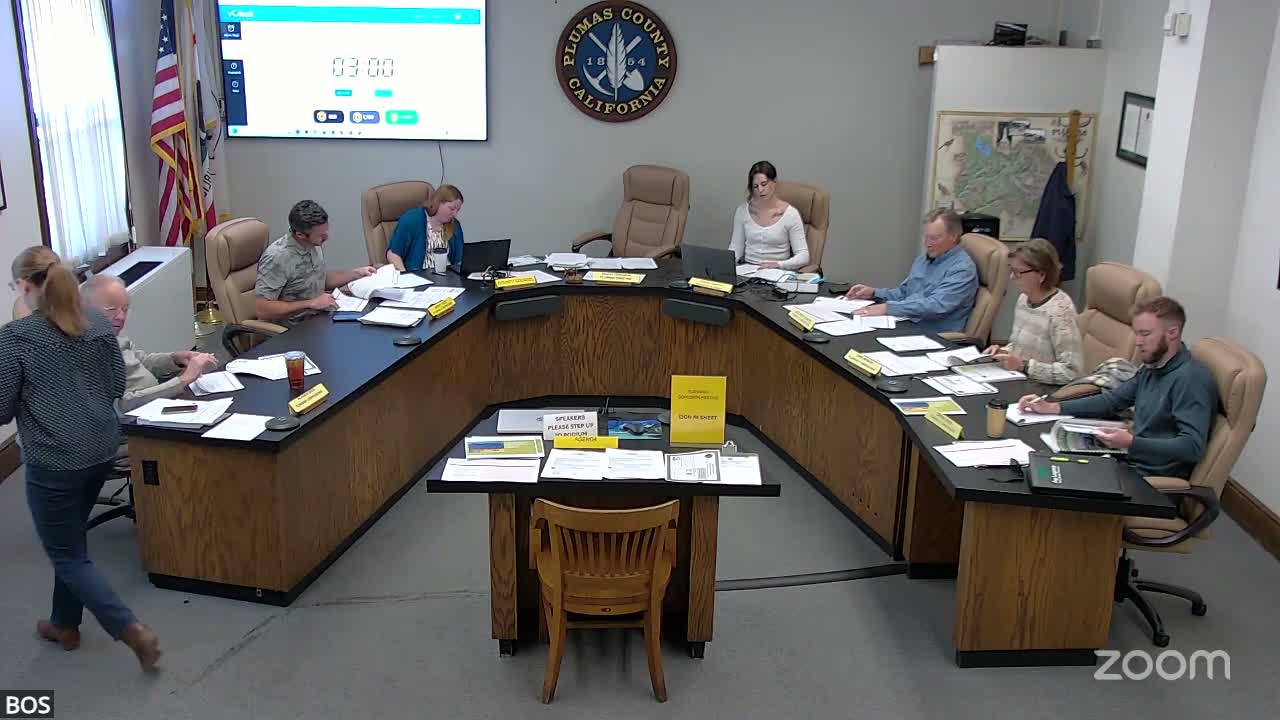
At its April 16 meeting the Plumas County Planning Commission conducted a detailed review of the agriculture and forestry element of the county's 2035 General Plan, focusing on Goal 8.12 (timber resource lands) and associated policy and implementation language.
Planning staff (Speaker 5) walked commissioners through findings required for discretionary approvals affecting timber resource lands, including provisions that a proposed use "will not significantly detract from the use of the property for or inhibit growing and harvesting timber" and other findings addressing conflicts, access and buffering. Commissioners probed the meaning of words such as "detract" and "inhibit," asking whether the terms were sufficiently precise for future consistency findings.
Commissioners also repeatedly emphasized the distinction between the general plan—which the staff characterized as a "50,000‑foot" visionary document—and the code, which contains enforceable provisions. "This is the 50,000 foot where we look at how to implement our code," one commissioner said, cautioning that policies in the general plan must be translated into codified standards to be enforceable.
Staff discussed multiple implementation measures linked to the policies, such as protecting resource transportation routes (roads used for timber and resource access), clarifying responsibilities for road impacts from heavy harvest traffic, and maintaining an inventory of industrial property for forest products manufacturing. The planning director noted that implementation measures vary by priority and capacity, and that some policies are intentionally aspirational while others will need concrete implementation steps in code.
Commissioners flagged questions for counsel and staff, including whether the board of supervisors has formally declined to entertain new Williamson Act contracts since subvention changes and how to craft ordinance language for conversion mitigation ratios (a proposed 1:1 no‑net‑loss requirement for converted agricultural acreage). Staff agreed to research outstanding legal questions and to prepare implementation language where appropriate.