Get Full Government Meeting Transcripts, Videos, & Alerts Forever!
Get email alerts on the Telecommunications topic
No spam. Unsubscribe anytime.
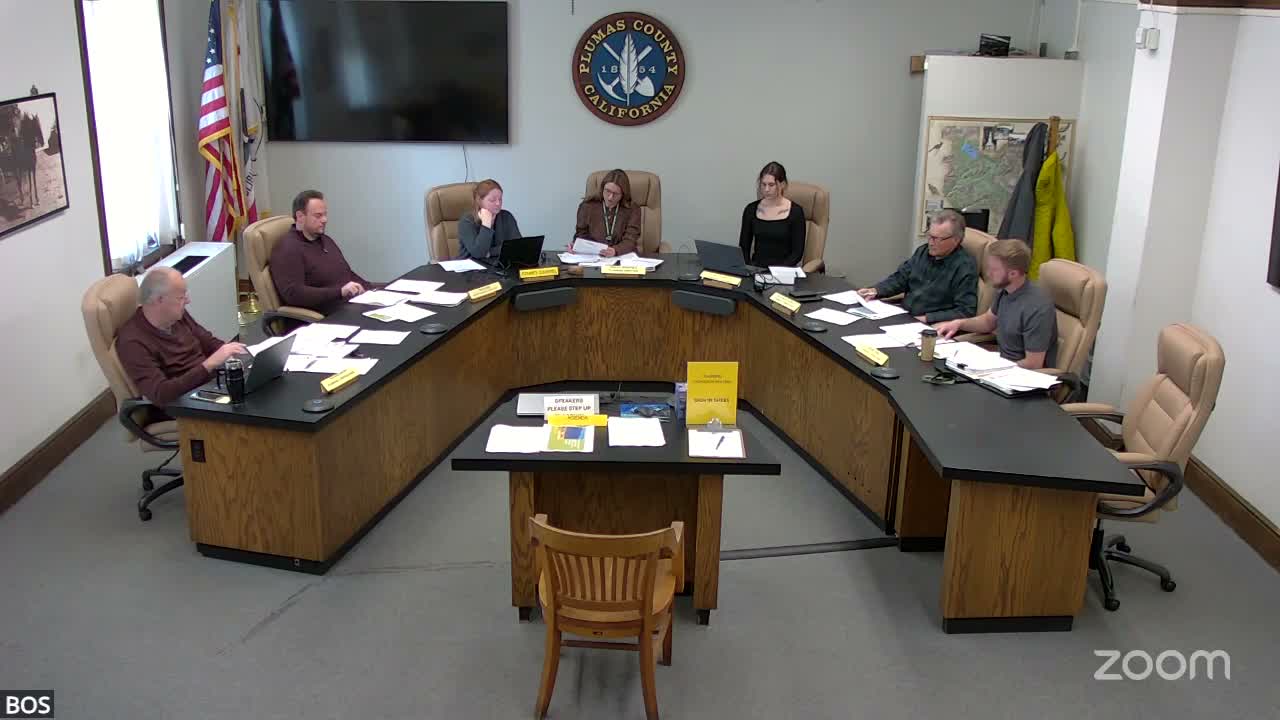
Plumas County planning commission moves to remove TPZ exemption for new telecom facilities, expand public and tribal notice
Summary
At a workshop, the Plumas County Planning Commission directed staff to draft ordinance language removing the timber production zone (TPZ) exemption for new telecommunications facilities, to increase public noticing (staff recommended 1,000 feet with higher tiers for taller towers) and to develop a proactive tribal notification list; staff will consult county counsel on whether emergency ordinance findings are feasible and preliminarily targeted a public hearing for May 7.
The Plumas County Planning Commission took steps at a workshop to tighten local oversight of new telecommunications facilities by removing an exemption that previously allowed certain installations in timber production zones to proceed via ministerial building permits.
Commissioners and county planning staff said the immediate goal is to amend the telecommunication ordinance (Article 41) to make new facilities in TPZ subject to either a zoning clearance certificate or a special use permit, bringing those sites into the discretionary review process.
“Staff is recommending 1,000 feet,” Tim Evans, senior planner, said of a proposed public hearing-notice radius that would replace the state baseline of 300 feet for discretionary actions. The commission discussed tiered notice distances for taller towers (examples discussed ranged between 1,000 and 1,500 feet) and asked staff to prepare draft language for review.
Why it matters: Commissioners cited a recent case in Greenville where an operator used the TPZ exemption to secure ministerial approval and build a tower without the wider notice and review that would attend a discretionary permit. Several public commenters said the lack of timely notice prevented residents and tribal members from learning about projects until after they were already under way.
Public input at the workshop focused on health, visibility and process. Residents and advocacy groups urged broader notice, stronger setbacks and tougher post-approval reporting requirements; several speakers urged the county to consider an emergency ordinance or moratorium to close the TPZ loophole immediately. County counsel advised the commission that emergency ordinances require legally defensible findings and that staff would evaluate whether those findings are supportable.
Technical issues and standards were debated at length. Patrick Presell, a radio-frequency engineer who addressed the commission, said regulatory reviews assume worst-case exposures and urged the county to rely on standard RF compliance reports stamped by licensed engineers. Other commenters pressed for more transparent RF data and for rules that cover near-field impacts, fixed wireless devices and future equipment upgrades.
The commission directed staff to: - Draft the form-and-format ordinance language to remove the TPZ exemption and to fold TPZ parcels into the existing ZCC (zoning clearance certificate) / SUP (special use permit) process; - Propose public hearing-notice distances (staff suggested 1,000 feet as a baseline and discussed 1,500 feet for taller structures) and options to scale notice by tower height; - Develop a proactive tribal notification list (tribes/tribal members would opt in) and consult with tribes about the process; and - Consult county counsel about whether emergency findings could be drafted to accelerate codification.
The commission asked staff to post the redlined ordinance text and the public comments to the planning department website and to provide technical materials (RF reports and comparisons from other counties) to commissioners for further review. Staff said the earliest practical public hearing for the TPZ-focused amendment would be May 7 if all noticing and legal requirements can be met; otherwise the matter could move to a later meeting.
What remains unresolved: The commission agreed to prioritize removal of the TPZ exemption as a near-term fix and to address broader loopholes (setbacks, specific exemptions and design standards) in a second phase. Several commenters pressed for larger notice distances (one speaker suggested up to five miles) and for stricter setback and post-approval conditions; commissioners asked staff to evaluate practical impacts (parcels too small to meet large setbacks and the potential need for variances).
Next steps: Staff will prepare the ordinance draft, gather background materials and consult with county counsel and relevant stakeholders, including tribal representatives and the school district, before the commission considers the form-and-format ordinance at a subsequent meeting and forwards a recommendation to the Board of Supervisors.
Representative quotes
“Staff is recommending 1,000 feet,” Tim Evans, senior planner, said of the proposed public notice radius.
“Remove the TPZ exemptions and increase public noticing up to 5 miles,” said Josh Hart, director of Feather River Action, urging a more protective approach during public comment.
“The science is there,” Patrick Presell, a radio-frequency engineer, said while urging engineering-based RF analysis for permitting.
The commission did not take a formal ordinance vote at the workshop; it directed staff to draft language and to return for hearing and recommendation. The commission indicated a public hearing on the TPZ portion was tentatively targeted for May 7, pending notice requirements and county counsel review.