Get Full Government Meeting Transcripts, Videos, & Alerts Forever!
Get email alerts on the Budget Supplement Sf4059 topic
No spam. Unsubscribe anytime.
Senate passes supplemental finance omnibus after hours of debate; key amendments fail
Summary
The Minnesota Senate passed a supplemental finance omnibus (SF 40‑59) on May 5, 2026, after floor debate and roll-call votes on amendments covering education, energy assistance, agriculture, environment, battery stewardship and Medicaid fraud funding. Several policy amendments failed while others were adopted; the bill passed 35–31.
The Minnesota Senate passed a supplemental finance omnibus, Senate File 40‑59, after extended floor debate on Tuesday, May 5, adopting the measure by a roll-call vote of 35 to 31.
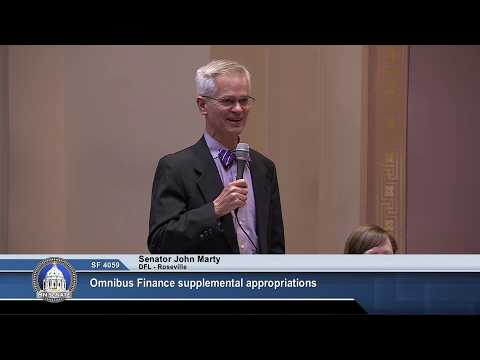
The omnibus includes targeted supplemental appropriations and policy adjustments intended to address student grant shortfalls and other urgent needs between biennial budgets. Sponsor and finance committee chair Senator John Marty said the bill focuses on “priorities to help the people of Minnesota in between budgets,” pointing to $52 million added to the state grant program for higher education and $15 million for low-income energy assistance (LIHEAP). “Students are doing exactly what we’re asking — attending our colleges — and we must help,” Marty said.
Major provisions and floor outcomes
- Higher education: The bill directs $52 million to the Minnesota State Grant program to partially address an estimated $131 million shortfall, a central focus of debate during the higher education article.
- Education and K–12: The education article contains hold‑harmless language for compensatory and literacy aids and a department-reported gender‑neutral bathroom grant extension; several amendments on K–12 funding and policy were offered and debated.
- Energy and LIHEAP: The energy articles include $15 million for low‑income energy assistance. Senator Rehrig won adoption of Amendment A28 to cap portions of administrative fees for that program (41–25), aiming to ensure a higher share of funds reach households in need.
- Jobs and workforce: The jobs article lists roughly $4.9 million in workforce development appropriations, funding a mix of pipeline programs, youth workforce training, and the ‘Made in Minnesota’ manufacturer support program.
- Agriculture and environment: Senator Putnam’s motion to remove the agriculture articles (A39) was adopted overwhelmingly (66–0), sending those provisions for separate consideration. Environment and recycling amendments drew lengthy debate; a proposal to exempt long‑life packaging from producer responsibility (A20) failed (31–35).
- Timber permits: The Senate adopted an amendment (A19) providing a one‑year extension for eligible timber permits to address market disruptions; that amendment passed by roll call (43–23).
- Battery stewardship: Article 7 would establish a producer‑funded battery stewardship program; an attempt to delete the article (A21) failed (31–35) after supporters warned of recycling fires and municipal disposal costs.
- Worker protections: A proposal to restore a general “right to sit” for employees (labor provisions) survived committee debate, while a motion to delete that provision (A23) was not adopted (31–34).
- Medicaid fraud enforcement: The bill adds resources to the Attorney General’s Medicaid Fraud Control Unit (MFCU), with a $1.23 million state appropriation intended to leverage a federal 3:1 match to hire additional staff. Sponsor Senator Erin Johnson Stewart described the change as an investment that will increase the unit’s capacity to recover funds and pursue criminal and civil cases.
Key contested amendment on sports-team designation
Senator Jim Nelson’s A29 amendment would have required school teams be designated by biological sex at birth and directed the Minnesota State High School League to update its rules. Nelson argued the amendment was necessary to protect girls’ sports and federal Title IX funding. Opponents — including Senators Maquade and Holmstrom — called the amendment discriminatory and argued it was unconstitutional and harmful to transgender students. The amendment failed on a roll call, 32–34.
Passage and next steps
After votes on dozens of amendments across the articles, the Senate gave final passage to SF 40‑59 by a 35‑31 margin and agreed to the bill’s title. Sponsor Senator Marty said the supplemental bill addresses urgent needs — from student grants to energy assistance — while trying to keep policy additions minimal and tied to finance provisions.
The Senate also considered and passed an unrelated health‑occupations omnibus (SF 32‑98) later in the day, which included licensure updates across multiple health professions.
What to watch next
Because the legislature is bicameral, next steps include any House consideration and potential conference committee work where the two chambers resolve differences. Several provisions deleted or amended on the floor — notably the agriculture articles removed by A39 — are likely to return in standalone bills or as bargaining items in conference negotiations.
Votes at a glance (selected)
- Final passage, SF 40‑59 (supplemental finance omnibus): Passed, 35–31 (roll call recorded on the floor). - A39 (remove agriculture articles 4 & 5): Adopted, 66–0. - A29 (sports-team biological sex designation): Not adopted, 32–34. - A18 (divert Cookie Cart funds to rural hospital training): Not adopted (roll-call defeat reported earlier in debate). - A19 (one‑year timber permit extension): Adopted, 43–23. - A20 (cardboard recycling exemptions): Not adopted, 31–35. - A21 (delete battery stewardship article): Not adopted, 31–35. - A28 (cap LIHEAP administrative costs): Adopted, 41–25.
The Senate will transmit measures and adopted amendments to the House and, where necessary, appoint conference committees to resolve differences.
Reporting notes: Quotations and attributions in this article are limited to speakers who self‑identified or were explicitly called by name on the Senate floor in the record. Vote tallies and amendment outcomes are taken from the floor roll‑call announcements recorded during the session.