Get Full Government Meeting Transcripts, Videos, & Alerts Forever!
Get email alerts on the Municipal Budgeting topic
No spam. Unsubscribe anytime.
Alta budget committee weighs transient room tax, modest property tax bump to shore up FY2027 budget
Summary
The Alta Town budget committee reviewed a draft FY2027 budget and discussed revenue options including a $100,000 property‑tax assumption and a proposed transient room tax (TRT) estimated to bring in roughly $200,000; members also discussed shifting shuttle funding from voluntary lodge contributions to a dedicated revenue source.
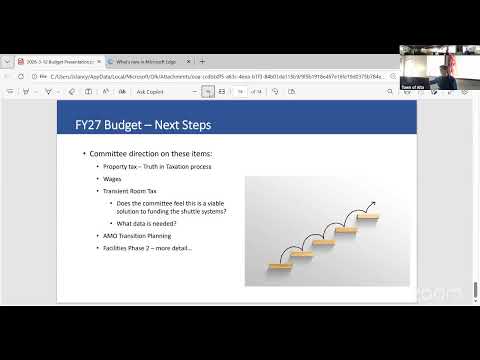
The Alta Town Council budget committee reviewed the draft FY2027 budget and discussed new revenue options Wednesday, including a $100,000 property‑tax assumption tied to the truth‑in‑taxation process and a proposed transient room tax that staff estimated could bring in roughly $200,000.
Chair (S3) led the presentation and said staff kept sales‑tax forecasts conservative and inserted a $100,000 property‑tax line item to reflect a truth‑in‑taxation filing; he told members he would circulate the detailed 15‑page draft budget for review. Committee member (S2) moved to adopt the prior meeting’s minutes at the start of the session; Roger Burke (S1) seconded and the committee approved the minutes unanimously.
The committee spent substantial time on the transient room tax (TRT). Chair (S3) showed a county comparison indicating many peer jurisdictions impose TRT and said, “if we were to impose this, we would probably bring in another $200,000 plus” (S3). Members discussed typical TRT uses — tourism marketing, destination services and programs — and debated tying TRT revenue to specific community benefits. Several members proposed using TRT receipts to replace voluntary lodge contributions and guarantee shuttle funding in exchange for the new tax.
Agency official (S5), who fields public‑safety questions for the town, told the committee the police department staffs at a minimal level and that additional costs tied to transient visitors are difficult to quantify without scheduling extra deputies; he offered to provide statistics on calls for service and officer time allocation to inform future decisions.
Committee member (S2) urged direct outreach to lodges before advancing the measure, suggesting staff call major lodging operators to gauge their business outlook and likely reaction. Staff and councilors agreed that using a “quid pro quo” — for example, dedicating TRT revenue to the shuttle program — could strengthen public messaging and make the proposal more defensible to lodging operators and residents.
On process, staff and members said a TRT would require a clear public process (ordinance or resolution), prominent placement in public notices and face‑to‑face engagement with lodges; it would not be “buried” in the budget. Members also discussed timing implications for lodging rate setting and the administrative delay between adopting a TRT and its appearance on hotels’ bills.
Where it stands: the committee did not adopt a TRT ordinance at the meeting; members asked staff to collect more data from lodges and the marshal’s office and to circulate the full draft budget for follow‑up. The committee did vote to approve the prior meeting minutes as a procedural action during this session.