Get Full Government Meeting Transcripts, Videos, & Alerts Forever!
Get email alerts on the State Legislation 2025 topic
No spam. Unsubscribe anytime.
Rancho Cordova staff summarize 2025 California laws, highlight housing and Brown Act changes
Summary
City staff briefed the council on more than a dozen new state laws, emphasizing housing measures that expand adaptive reuse, TOD standards, and stronger enforcement fines, as well as major Brown Act modernizations that expand virtual participation and accessibility requirements.
City staff and legal advisers reviewed a series of 2025 California laws for the Rancho Cordova City Council, telling members the year’s legislative package was heavy on housing measures and changes to local government transparency and remote participation rules.
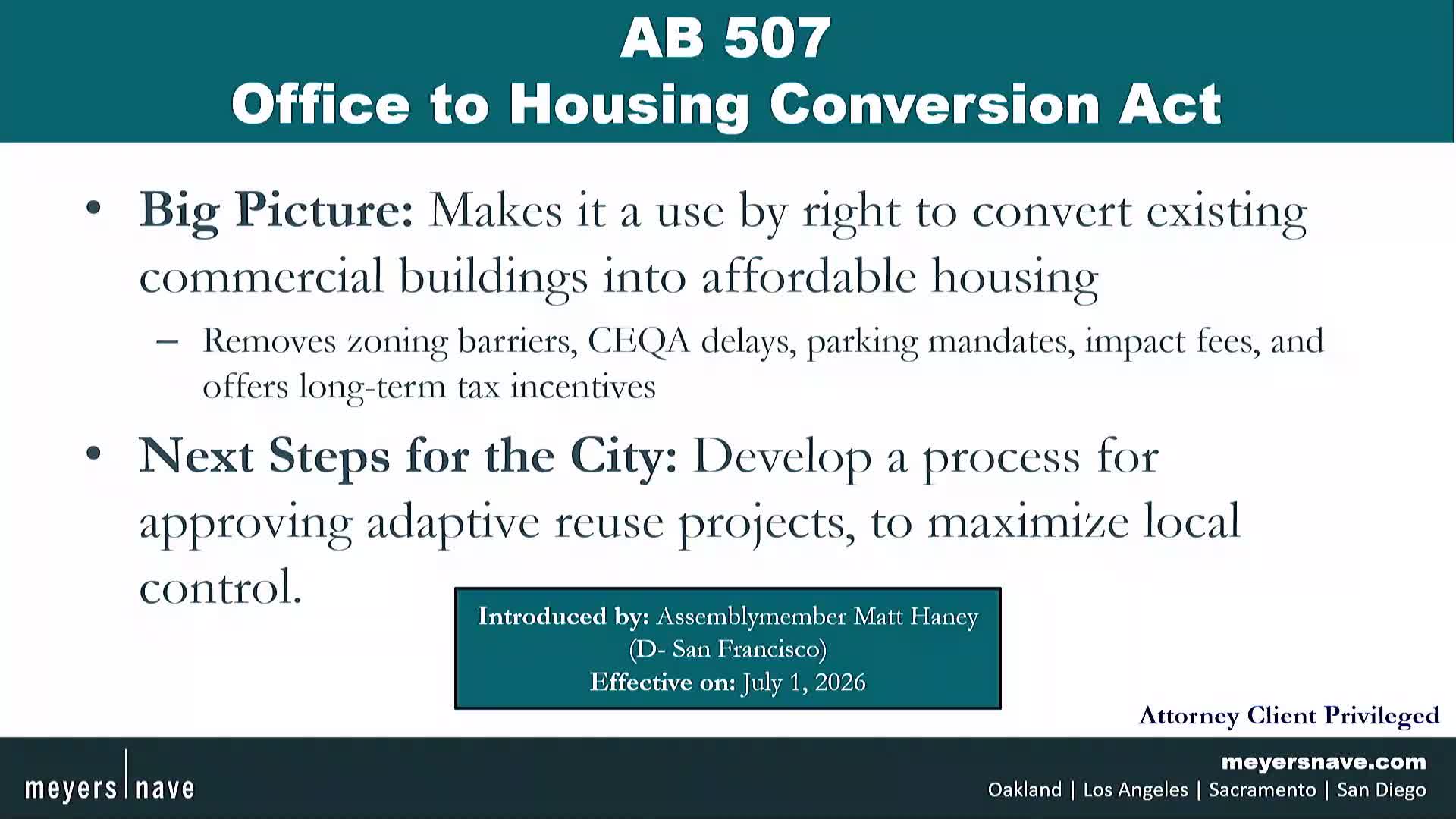
Anthony Amar summarized key bills that the council and departments should track. On adaptive reuse, he said, “AB 507…simplifies the process to turn empty or underused commercial buildings into housing,” explaining the statute allows eligible adaptive‑reuse projects to proceed by right in most zones and requires minimum affordable units depending on tenure.
Staff also outlined SB 79, which sets statewide minimums for housing near major transit stops, and AB 712, which strengthens enforcement of state housing laws and adds statutory fines and attorney’s‑fee recovery for successful developer challenges. AB 648 was noted for exempting community college district land from certain local zoning restrictions for housing projects near campuses.
On land‑use and industrial siting, staff explained SB 415 (a cleanup to AB 98) clarifies what counts as a sensitive receptor and adds definitions — including a Logistics Park concept — and includes buffer and truck‑access standards for large logistics projects.
The presentation also previewed a significant Brown Act modernization that staff and the City Clerk said expands allowances for remote participation, raises accessibility and translation requirements, and reorganizes rules for different types of legislative bodies; staff recommended a forthcoming workshop to address implementation and operational policies.
City staff repeatedly cautioned that many of the new laws permit local implementation choices (ordinances or alternative plans) but limit the kinds of objective criteria the city may apply; staff urged early local policy work so Rancho Cordova can preserve community priorities while complying with state requirements.
Council members asked clarifying questions about timelines and operational impacts; staff noted key effective dates (some laws effect in 2026) and recommended follow‑up workshops with departments and a detailed Brown Act training session with the city clerk.