Get Full Government Meeting Transcripts, Videos, & Alerts Forever!
Get email alerts on the Land Use topic
No spam. Unsubscribe anytime.
Council approves Massachusetts Point rezoning, citing community benefits and mitigation in final EIR
Summary
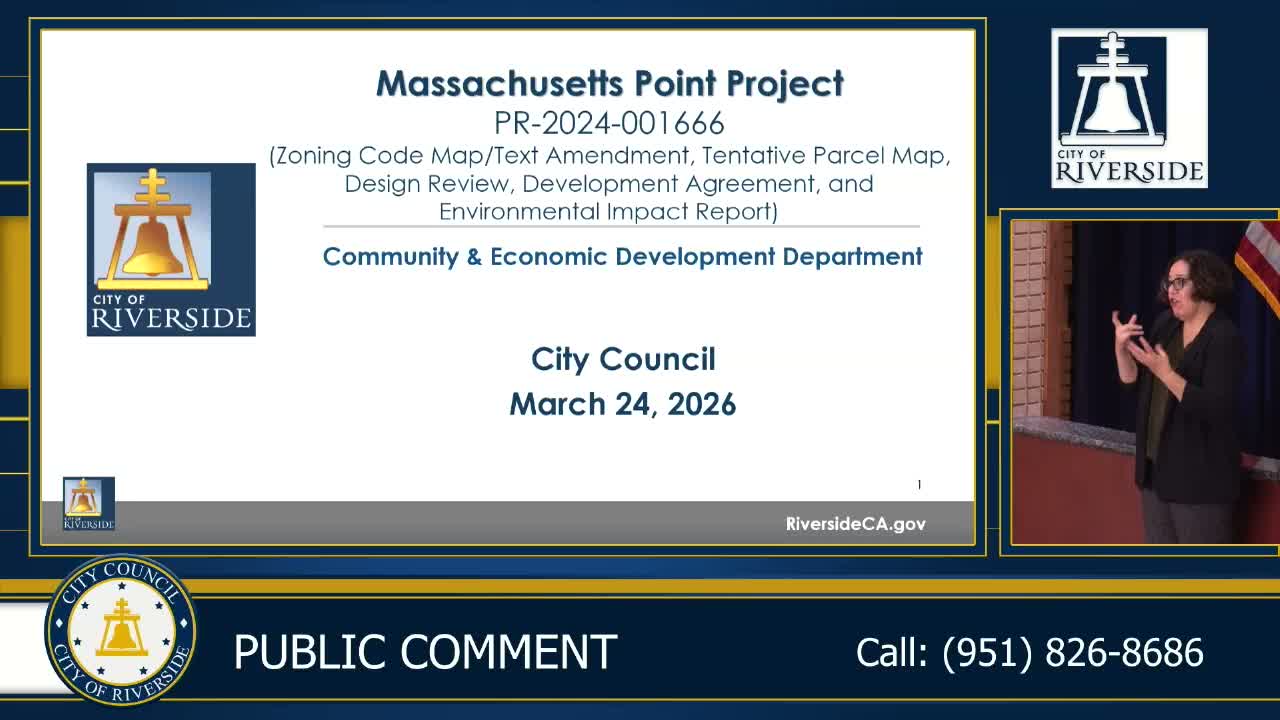
The City Council unanimously approved zoning changes, a tentative parcel map, design review, a development agreement and certification of a final EIR to allow two warehouses at the Massachusetts Point site; staff said environmental impacts have been mitigated and the project carries negotiated community benefits.
The Riverside City Council on March 24 voted unanimously to approve the Massachusetts Point development entitlements, clearing the way for two new industrial warehouse buildings on roughly 14.42 acres in the Innovation District Overlay Zone.
Senior planner Candace Azazadeh told the council the proposal includes a zoning map and text amendment, a tentative parcel map, design review, a development agreement and a final environmental impact report. Building 1 is planned at about 99,900 square feet and Building 2 about 99,950 square feet, with employee open‑space areas and docking interior to the site. Azazadeh said the final EIR and mitigation monitoring program conclude that “all impacts related to the proposed project have been identified as less than significant or have been reduced to below the level of significance with mitigation.”
Residents and advocates raised concerns during public comment. Mike McCarthy of the Sierra Club Box Springs Group, who also identified himself as vice chair of R Now (Riverside Neighbors Opposing Warehouses), opposed the project over pollution, traffic, land‑use compatibility and the absence of a labor agreement, saying, “We don’t like the pollution. We don’t like the traffic. We don’t like the land use.”
Council member Siobhan Cervantes, whose district includes the site, summarized the years‑long review and said the city and applicant worked through closed‑session settlement talks before bringing the project public. She listed the negotiated community benefits that were included in the package: $250,000 for public art, $250,000 for Riverside City College workforce training, $250,000 for Innovation District signage and $100,000 to market the Innovation District. Cervantes moved to approve the staff recommendations.
Council and staff also addressed questions about AB 98 and truck‑routing rules. Azazadeh and city staff said the project is exempt from AB 98 requirements because it was submitted before the statute’s cutoff date and that the city’s comprehensive General Plan update will provide a longer‑term approach to truck routes and circulation consistent with state law.
After council discussion the mayor called for a vote and the clerk announced the motion passed unanimously. The council approved the EIR findings, adopted associated planning cases and authorized the development agreement. Councilmembers and staff said monitoring and the mitigation program will be part of the city’s conditions of approval.
Unless the developer requests changes to the adopted approvals or appeals are filed, building permits and implementation steps now move to the city’s planning and building processes. The contract terms in the development agreement will be recorded and staff said the chief financial officer will record increases in revenues related to developer deposits for public art and marketing.