Get Full Government Meeting Transcripts, Videos, & Alerts Forever!
Get email alerts on the Biodiversity Data Infrastructure topic
No spam. Unsubscribe anytime.
Montana Natural Heritage Program urges Missoula audience to use iNaturalist to fill invertebrate data gaps
Summary
At a Missoula lecture, Bryce Maxwell described the Heritage Program’s tools and partnerships, outlined large gaps in invertebrate records, and encouraged residents to submit and help identify observations via iNaturalist to aid conservation and invasive‑species response.
Missoula — Bryce Maxwell, program coordinator for the Montana Natural Heritage Program, told an audience in Missoula that residents can play a key role in strengthening the state’s biodiversity data by submitting photos and observations to iNaturalist and the Heritage Program’s online tools.
"We inform decision processes quickly and we provide as much certainty as possible," Maxwell said, summarizing the program’s mission. He described the Heritage Program as Montana’s central repository for species and habitat information, created by the Montana Legislature in 1983 at the request of The Nature Conservancy to give a common set of data for environmental review, permitting and planning.
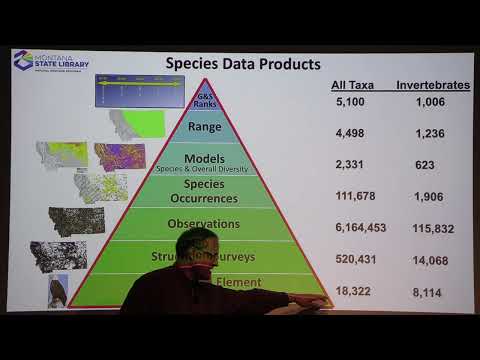
Why it matters: Maxwell said the Heritage database contains thousands of records but still shows large taxonomic and spatial gaps for invertebrates. He gave figures from his slides to illustrate the scale: the program manages information on roughly 18,322 taxa or habitats overall, has added millions of observations, and currently imports tens of thousands of iNaturalist records for Montana (the slides cited roughly 63,000 animal and 75,840 botanical records imported to date).
Details and evidence: Maxwell highlighted that the program lists about 7,658 arthropod species in its system while Montana could host 12,000–15,000 described arthropods, and he emphasized the need to associate invertebrates with host plants and habitats to improve conservation outcomes. He also described the Heritage Program’s modeling work — more than 2,300 species modeled, including 623 invertebrate species, and range polygons for thousands of species — and a cumulative invasion‑risk map that shows higher risk in parts of Western Montana.
How citizen science helps: Maxwell explained the program’s workflow with iNaturalist: when a record is identified by one of a vetted list of expert identifiers, the Heritage Program can import it automatically without staff time. "If you submit a bumblebee record in Montana, there's a guy, a John Asher, in Singapore who will probably identify within 24 hours," Maxwell said, citing the speed and scale of expert identifications on the platform.
Invasives and early detection: The program began centralizing nonnative species data in 2018 after zebra‑mussel concerns; Maxwell said the database now contains about 1,366 nonnative species and roughly 1.1 million observations from roughly 1,300 data sources, with regular exchanges to GBIF and the USGS non‑indigenous aquatic species system. He described an "800‑kilometer" nonnative watch list the program uses to flag species not yet in Montana so weed managers can prioritize early detection and rapid control.
Tools and access: Maxwell demonstrated the Heritage Program’s map viewer and an environmental summary report tool that he said more than 1,700 resource managers can run in under five minutes for any location; data are refreshed nightly so new survey uploads can appear in the next day’s reports. He also pointed attendees to free posters and field‑guide resources available at the event and online.
Partnerships and capacity: Maxwell credited partner projects and contractors — including the Montana Entomology Collection, Northern Rockies Research and Educational Services, the Montana Moth Project, Xerces Society work on bumblebees and individual contributors such as Dave Stagliano and Paul Hendricks — for contributing surveys, species accounts and mapping work. He said contractors are helping complete conservation status ranks for aquatic invertebrates within about a year.
Audience questions and next steps: During audience Q&A, a participant identified as Christy asked about georeferencing and fungal identifications; Maxwell said fungi experts are overwhelmed and recommended tagging specialists or using project filters to surface records for those experts. Maxwell closed by reminding attendees to take free posters and field guides and to visit the Heritage Program website for how‑to videos and identification resources.
What's next: The Heritage Program continues to expand ingestion of community science records, refine invasion‑risk models, and fill taxonomic and spatial gaps for invertebrates; Maxwell encouraged Missoula residents to submit observations, tag expert identifiers, and use the program’s map and report tools to help guide conservation and early invasive‑species response.