Get Full Government Meeting Transcripts, Videos, & Alerts Forever!
Get email alerts on the Zoning Text Amendment topic
No spam. Unsubscribe anytime.
Planning staff proposes ED‑zone rewrite to allow mixed‑use housing with 720‑unit cap; commissioners raise concerns
Summary
Planning staff presented a narrowly scoped text amendment to the ED (employment) zone to let mixed‑use residential above nonresidential floors while capping total ED residential at 720 units and requiring at least 15% nonresidential floor area in mixed‑use buildings. Commissioners raised process and land‑use concerns and asked for a work session.
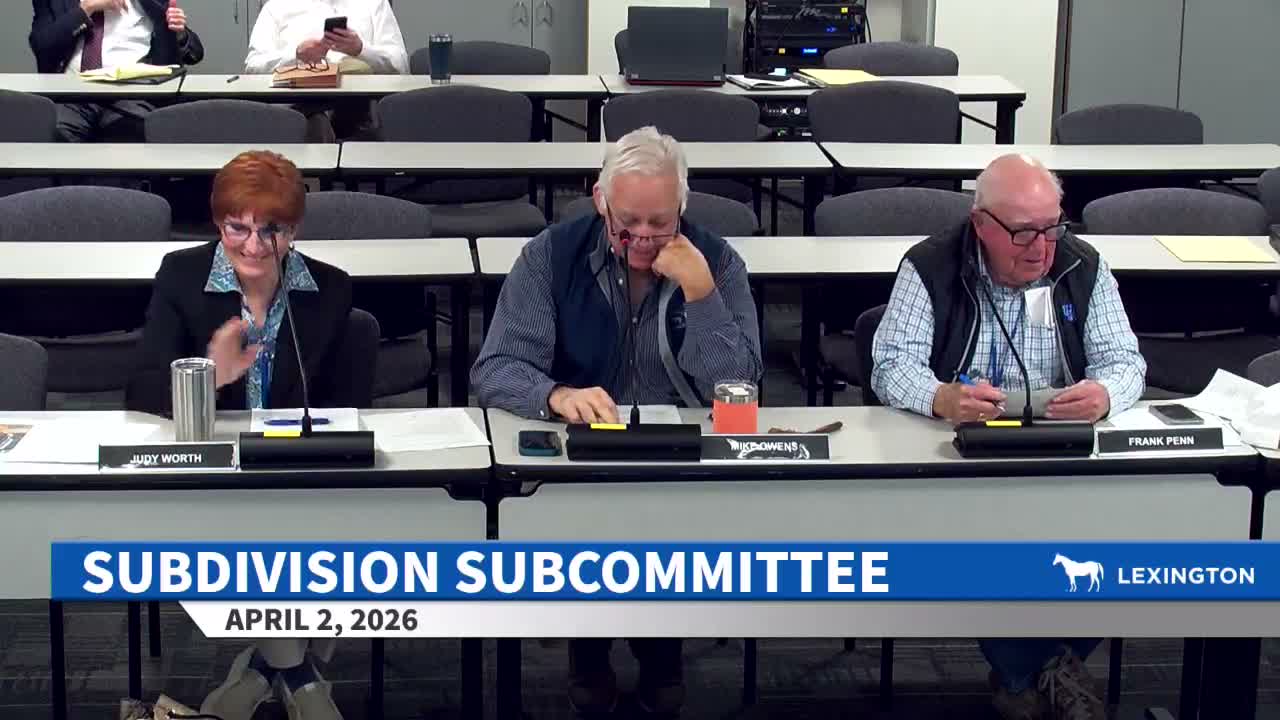
Planning staff on April 2 outlined a proposed change to the ED (employment/development) zoning text that would allow more residential units inside mixed‑use buildings while placing new limits and guardrails on that development.
Daniel Crum, planning staff, told the Subdivision Committee the amendment would count first‑floor residential against a building’s residential total while allowing units above the first floor to be treated differently, and would cap total residential across all ED properties at 720 units. "The applicant is seeking more flexibility to do mixed use, but now implementing a hard cap that prevents that from growing outside the scope," Crum said, summarizing staff’s recommended language.
The draft also would require mixed‑use buildings to include a minimum amount of nonresidential space—staff proposed at least 15% of the building’s floor area on the ground floor be nonresidential—intended to prevent token commercial spaces, Crum said. He described the change as the product of roughly two years of edits and stakeholder meetings with the ED property owners and civic groups.
Applicant representatives said the edits respond to an existing 1996 ED framework that has not produced the expected job‑generating development. "We're preserving flexibility while keeping a cap," one applicant representative said, adding that the changes would encourage mixed‑use buildings and retain nonresidential activity.
Several committee members pushed back, saying the amendment reads like a site‑specific accommodation that effectively permits residential on ED land. One member warned that repeated site‑specific changes have accumulated over time and urged the commission to consider a broader work session before acting. "If we're going to take ED land and make it residential, we should decide that as a body," the commissioner said.
Supporters and staff said the draft includes guardrails—the 720‑unit cap and the 15% nonresidential minimum—to balance reuse with the zone’s job‑production goals. Staff said they would present a redline comparison of applicant and staff language and that further discussion was planned at the zoning subcommittee later in the day.
Next steps: staff will circulate edits and a redline and return to the commission for further review; several commissioners requested a dedicated work session to examine the policy tradeoffs before a formal vote.