Get Full Government Meeting Transcripts, Videos, & Alerts Forever!
Get email alerts on the Missing And Murdered Indigenous People topic
No spam. Unsubscribe anytime.
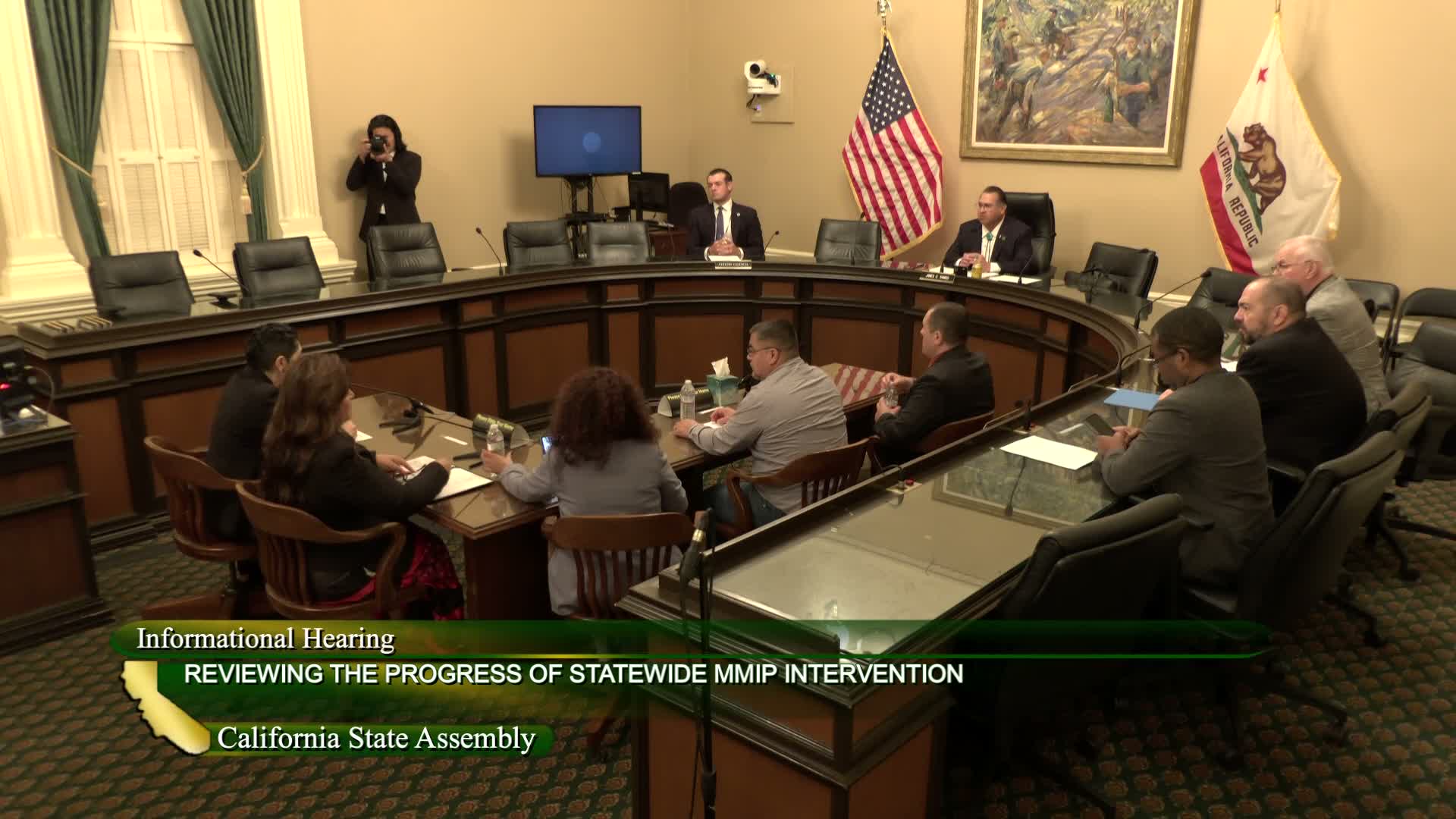
Tribal leaders to California Assembly: sustain MMIP funding, fix data and jurisdiction gaps
Summary
Tribal leaders told the Assembly Select Committee on Native American Affairs that recent investments (including MMIP grants and the Feather Alert) have helped, but urged sustained funding, mandatory statewide MMIP tracking, clearer regional response agreements and expanded tribal capacity to prevent cases from ‘falling through the cracks.’
Tribal leaders from across California told a State Assembly select committee on May 5 that progress on missing and murdered Indigenous people (MMIP) initiatives is real but fragile, and that the state must convert one-time grants into ongoing funding, fix jurisdictional confusion under Public Law 280, and improve data collection and tribal access to case systems.
“Over the past 2 years, the state's missing and murdered indigenous people grant program has directed nearly 33,000,000 in critical resources to tribes,” said Bridal Pinto, chairwoman of the Hamul Indian Village Reservation, noting that those investments have supported investigations, data collection and community-based prevention but “they are not a substitute for long term investment.”
Multiple tribal chairs recounted personal, unresolved cases and urged immediate improvements in three areas: (1) real-time regional response systems and formal agreements between tribes and local law enforcement to clarify leadership and communications; (2) mandatory, transparent MMIP tracking that includes tribal input so cases are not misclassified or invisible in state databases; and (3) sustained tribal capacity funding to build tribal law enforcement, victim services and prevention programs.
“Too often, no one investigates because no one is clearly responsible for investigating,” said Diane Kamalani, a tribal chairperson who described an unsolved family case and called the pattern “systemic neglect.” She said gaps in jurisdiction and media visibility create what she called “a cloak of invisibility” over tribal victims.
Assembly members pressed for specific next steps. Members and tribal leaders discussed region-based MOUs, formalized tribal liaisons with county sheriffs and district attorney offices, and targeted training at the POST level on Public Law 280 and tribal sovereignty. The chair and several members emphasized the need to preserve newly built infrastructure rather than let it collapse when short-term grant cycles end.
Why it matters: Witnesses and legislators described MMIP as both a public-safety and child-welfare issue that intersects with foster-care placement, human trafficking and long-standing social harms tied to colonization. Panel testimony and public commenters repeatedly framed data gaps and misclassification as central obstacles to allocating resources and pursuing prosecutions.
What’s next: The committee left the hearing with clear requests for ongoing budget support, expanded training, and legislative or administrative fixes to improve data sharing and the Feather Alert activation process. The committee indicated it will continue follow-up work with the Department of Justice, the California Highway Patrol and tribal partners.