Get Full Government Meeting Transcripts, Videos, & Alerts Forever!
Get email alerts on the Implementation And Fiscal topic
No spam. Unsubscribe anytime.
What would change: staffing, budgets and local officials’ concerns about the governor’s governance plan
Summary
The governor’s proposal would transfer deputies and many CDE staff to a new commissioner structure effective Jan. 1, 2027, with May Revision budget language to make the shifts cost neutral; county and local leaders urged clearer implementation details and simpler reporting requirements.
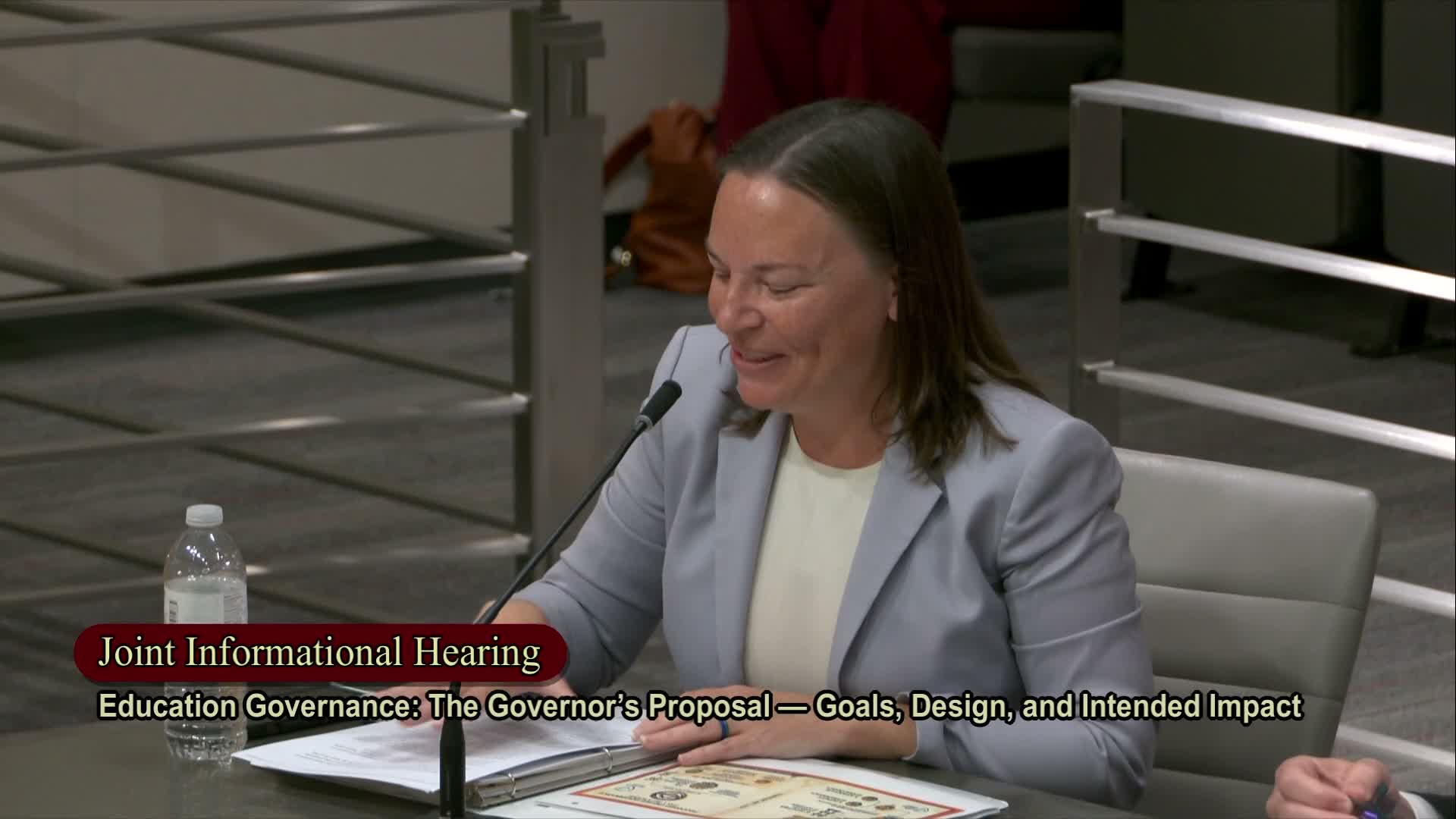
Amber Alexander of the Department of Finance told the committee the governor’s plan would transfer six governor‑appointed deputies and with them associated budget authority from the State Board of Education to the California Department of Education, with the shifts effective Jan. 1, 2027. She said the May Revision would include provisional language to reduce the State Board item by the half‑year cost and increase the department’s main operations item, and that full costs would be reflected in the 2027–28 budget.
‘‘These 6 deputies are currently funded within the State Board of Education budget item ... The governor’s budget proposal will transfer these 6 deputies to the Department of Education, and they will report to the education commissioner as of 01/01/2027,’’ Alexander said.
The plan anticipates that ‘‘with some exceptions, all civil service employees of the State Board of Education that are engaged in functions that are transferred to the education commissioner will also be transferred to the Department of Education as of 01/01/2027,’’ she added.
Supporters said the staffing and budget transfers are intended to keep functions together and make the department a single, accountable administrative body for statewide implementation. Sarah Cortez of the Legislative Analyst’s Office recommended a cost‑neutral fiscal plan and asked the Legislature to consider Senate confirmation of the commissioner to preserve oversight.
Local leaders pressed for operational clarity. Ed Manansala, El Dorado County Superintendent, said county offices support clearer governance because ‘‘when state direction is fragmented, it’s schools and districts that absorb the cost often in the form of conflicting priorities.’’ He and other county superintendents said districts experience substantial administrative burden and would benefit from consistent guidance and reduced duplication.
State Superintendent Tony Thurman warned the committee the proposal would remove roughly 1,500 staff from the SPI’s direct access and left the elected superintendent ‘‘unable to consult the director of special education or the director for families in migrant education’’ in the same way if the transfers proceed as proposed.
Committee members asked for concrete trailer language and a framework to monitor whether the reorganization reduces administrative burden and improves district support. Witnesses and analysts suggested proximal evaluation metrics—such as whether districts receive clearer, single‑source guidance and whether reporting burden is reduced—alongside any longer‑term student‑outcome measures.
No budget votes occurred at the hearing; the committee asked administration staff to provide detailed trailer bill language and fiscal notebook updates ahead of May Revision deadlines.