Get Full Government Meeting Transcripts, Videos, & Alerts Forever!
Get email alerts on the Education Governance topic
No spam. Unsubscribe anytime.
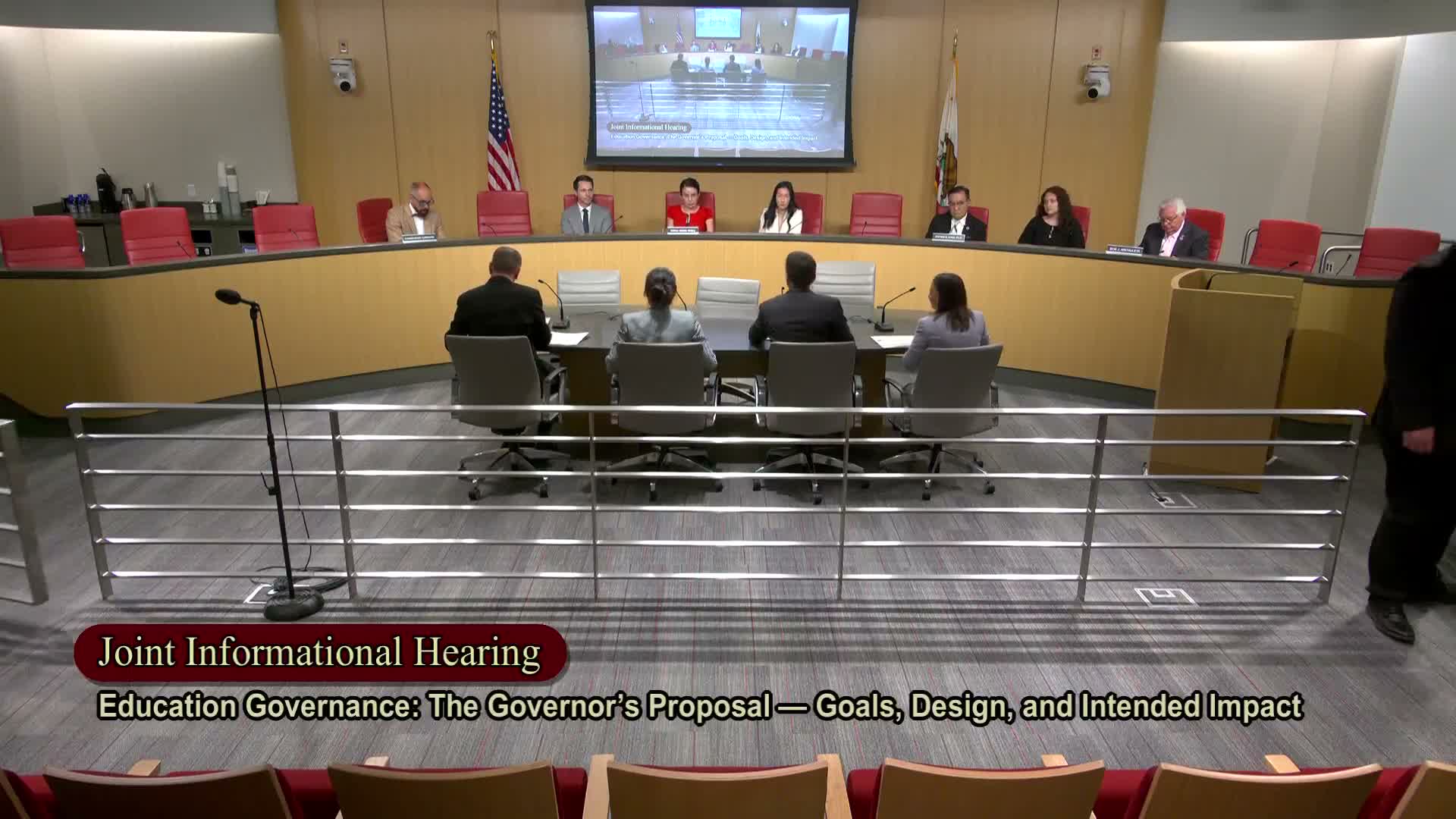
Senators weigh governor’s plan to create appointed education commissioner, critics warn it skirts the constitution
Summary
A joint Senate hearing heard administration and analyst arguments that an appointed education commissioner would clarify accountability at the California Department of Education, while critics — including the state superintendent and several senators — warned the change could weaken the elected superintendent’s role and sidestep the constitution during an election year.
Brooks Allen, executive director of the State Board of Education and an education policy advisor to Gov. Gavin Newsom, told the Senate Education and Budget committees the governor’s proposal would replace a ‘‘double-headed’’ system that fragments authority with a clearer administrative chain by making an appointed education commissioner the day-to-day manager of the California Department of Education (CDE).
Allen said the change aims to ‘‘bring greater accountability, clarity, and coherence’’ and to ‘‘allow the state to be held accountable for carrying out its roles in support of education delivery.’’ He framed the proposal as a statutory solution informed by decades of reviews and compared California’s model to more coherent systems in states such as Connecticut and New Hampshire.
The Legislative Analyst’s Office recommended the committee adopt the structural shift but urged refinements. Sarah Cortez of the LAO said the office supports creating an appointed commissioner while preserving ‘‘legislative oversight’’ and asked that the legislature consider requiring Senate confirmation of the commissioner and clearly defining the state superintendent’s duties in trailer bill language.
Amber Alexander of the Department of Finance outlined how the proposal would be phased: six governor‑appointed deputy positions and many civil‑service employees now budgeted under the State Board would transfer to the CDE and begin reporting to the education commissioner on Jan. 1, 2027, with May Revision budget language to effectuate a cost‑neutral half‑year transfer.
But the plan drew sharp objections. Tony Thurman, California’s state superintendent of public instruction, called the proposal an ‘‘end run’’ around the state constitution and said proponents had not identified measurable outcome metrics the restructuring would achieve. ‘‘If there was any single stretch of data to show that this would change student outcomes, I’d be the first person to sign on board,’’ Thurman said, adding that losing access to CDE staff would ‘‘weaken’’ the superintendent’s ability to serve voters.
Several senators echoed constitutional and timing concerns during the hearing. Senator Cobaldon, a member of the 2002 master plan working group, questioned whether making such a change during an election cycle and via the budget process — rather than a ballot measure — would be democratically appropriate. He also pressed administration witnesses on why savings from reduced duplication were not evident in the proposal.
Supporters argued the change would reduce friction and provide a single administrative contact point for districts. ‘‘The goal is one line so it’s completely clear that both the alignment of the policy authority of the State Board of Education and the day‑to‑day implementation within the department — that’s one line,’’ Brooks Allen said.
Experts at the hearing cautioned against overstating the evidence. Jeannie Myung of Policy Analysis for California Education said governance change could improve alignment if it clarifies responsibilities and builds CDE capacity, but noted that any reform should be judged by whether it reduces fragmentation and strengthens implementation. Claus von Zastrow of the Education Commission of the States emphasized that national research linking governance form to student achievement is thin and context‑dependent.
The committee did not vote on any bill. Members pressed for clearer implementation language, oversight protections, and concrete metrics for success before deciding whether to advance statutory changes.