Get Full Government Meeting Transcripts, Videos, & Alerts Forever!
Get email alerts on the Alpr And Traffic Cameras topic
No spam. Unsubscribe anytime.
Senate approves rules for automated license‑plate readers and limits on mobile traffic cameras with revenue directed to first‑responder pensions
Summary
The Senate passed Senate File 2284, adopting amendment s 52 42 which sets limits and governance for ALPRs and mobile traffic cameras: local ordinances required, Department of Public Safety approval required, facial‑recognition capabilities prohibited, 30‑day deletion of captured images, one‑year non‑deletable search logs with periodic audits, caps on mobile cameras by city size, and revenue splits directing proceeds to first‑responder pensions; passage was 31‑9.
The Senate passed Senate File 2284 after adopting floor amendments that establish state and local rules for automated license‑plate readers (ALPRs) and place limits on mobile traffic cameras.
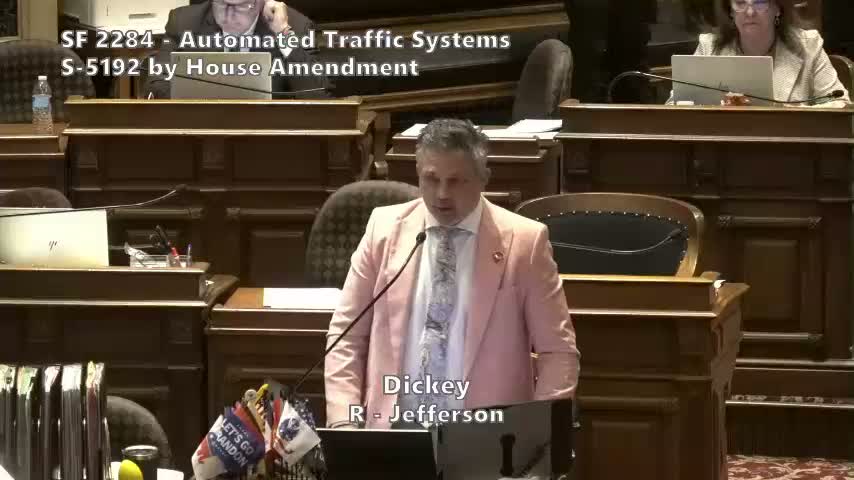
Senator Dickey (Senator from Jefferson) summarized the House amendment and floor amendment s 52 42. He said the amendment would require a city or county to pass an ordinance authorizing ALPR use and to specify in that ordinance the vendors and classifications of personnel authorized to access ALPR data. The amendment prohibits ALPRs that are enabled to recognize or identify a person by facial images and requires Department of Public Safety approval before an ALPR may be used by a local authority.
The amendment restricts searches of ALPR data to those related to a call for service or other cause; if an ALPR alert is generated, an officer must verify reasonable suspicion exists before taking action on the alert. Entities using ALPRs must keep a non‑deletable search log for at least one year; the log must record the name of the person performing the search, the reason, and an associated call or case number. Audits of the log are required every four months.
Senator Dickey said the amendment requires that all ALPR images and data be deleted no later than 30 days after capture, and it limits data sharing to listed lawful recipients (law enforcement agencies, contracted persons for specified public‑safety purposes, the National Insurance Crime Bureau or insurance organizations for fraud or recovery investigations, and legal processes when images are admissible under Iowa evidence rules). The amendment also states that no ALPR image or data may be used for marketing, profiling, or other commercial purposes; violations would be a simple misdemeanor.
Amendment s 52 42 made additional changes: it clarified that 'highway' includes city streets, removed a requirement to publicly post search‑log audits (making logs confidential under chapter 22), extended DPS approvals for state entities from annual to every two years, established a process for audits, limited most local authorities to two mobile cameras with higher caps for larger cities (up to four cameras for populations above 90,000 and up to five for populations over 250,000), and allocated mobile camera revenue toward first‑responder pension and benefits (50% for most cities; 100% of the fifth camera revenue for those cities that qualify) with the stated aim of providing property tax relief. The amendment also set signage and illumination standards for mobile cameras and staggered effective dates (signage effective 10/01/2026; ALPR provisions effective 01/01/2027; other provisions effective 07/01/2026).
Floor debate featured supportive remarks from Senators Busciano, Knox and Webster emphasizing cross‑aisle cooperation and the property‑tax relief potential of allocating revenues to pension funds. Senator Dickey framed the work as corrective to past local practices and urged a yes vote; the amendment was adopted by voice vote and the Senate concurred in the House amendment. The roll‑call vote on final passage recorded 31 yeas and 9 nays; the bill passed the Senate and was messaged to the House.
Why it matters: The enacted rules create statewide guardrails for local ALPR use, add privacy protections (short retention, audit requirements, prohibition on facial recognition), and place limits on mobile camera deployment and revenue use. The proposal shifts some oversight responsibilities to the Department of Public Safety while preserving local ordinance authority.
Next steps: The bill was messaged immediately to the House; the effective dates vary by provision and are specified in the adopted amendment.