Get Full Government Meeting Transcripts, Videos, & Alerts Forever!
Get email alerts on the Zoning Variance Appeal topic
No spam. Unsubscribe anytime.
Senate adopts change limiting written protest petitions in zoning disputes
Summary
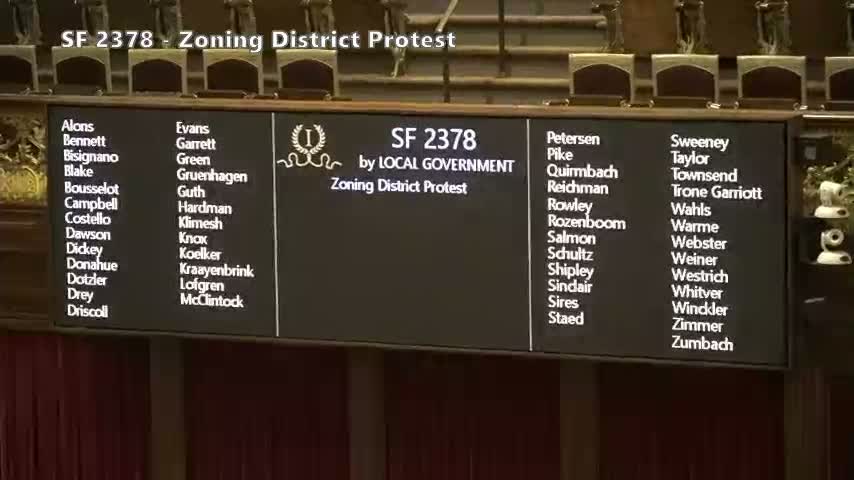
The Iowa Senate concurred with a House amendment and passed Senate File 2378, which removes a statutory provision allowing written protest petitions against proposed zoning changes and modifies appeal and council-override rules for variances; the bill passed 34-12 and was ordered messaged to the governor.
Senator Driscoll moved and the Iowa Senate on the floor concurred with House Amendment 51-76 and passed Senate File 2378, a bill that removes the statutory right to file written protest petitions against proposed zoning changes and adjusts appeals for variance decisions.
The amendment ‘‘allows for any individual affected by a variance to appeal the decision of the board to the council within 60 days,’’ and it states that ‘‘a variance effective date is stayed until the council considers’’ the matter, Senator Driscoll said. He also explained that the amendment ‘‘allows a city council to overturn a board's decision by 2 thirds vote of all council members, regardless of whether an appeal has been brought.’’
Senator Krombach urged colleagues to oppose the bill, arguing the current law provides ‘‘an extra degree of insulation, an extra degree of procedure before zoning changes can be made’’ and that property owners near proposed changes deserve those safeguards. ‘‘I urge a no vote,’’ Krombach said, citing concerns about impacts on homeowners’ market value and enjoyment of their property.
After debate the Senate adopted the House amendment by voice vote, read the bill for the last time, and conducted a roll-call vote that produced 34 ayes and 12 nays. The chair declared the bill passed by a constitutional majority and the Senate ordered the bill messaged to the governor.
The action changes local-appeal procedures for variances and gives city councils a defined mechanism to stay and review variance decisions; proponents said the measure increases municipal flexibility, and opponents said it reduces protections for nearby property owners.