Get Full Government Meeting Transcripts, Videos, & Alerts Forever!
Get email alerts on the Short Term Rentals topic
No spam. Unsubscribe anytime.
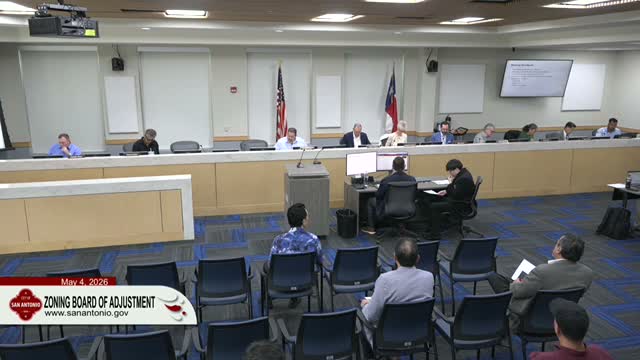
Board of Adjustment splits on short‑term rental requests; two density exceptions denied
Summary
The San Antonio Board of Adjustment denied special exceptions to allow additional Type 2 short‑term rentals at 122 Rio Vista and 1722 North Olive after commissioners split on density and hardship arguments; both motions failed after full hearings and roll‑call votes.
The San Antonio Board of Adjustment on Tuesday denied two requests to add Type 2 short‑term rental permits on block faces that would have exceeded the city’s 12.5% density cap.
Juan Alvarez, a planner with Development Services, told the board that staff recommended denial of the 122 Rio Vista request because approving a second Type 2 unit on that block face would raise the density above the code limit. Applicant Enrique Lavinman testified that he previously held a valid STR permit (issued Aug. 15, 2022), that his property had been maintained without neighborhood complaints, and that a lapse in the permit’s renewal occurred while he was out of the country. "I've never had a noise violation or anything like that," Lavinman said, adding he has a near‑5‑star host rating and invested more than $100,000 in the property’s rehabilitation.
Commissioners debated whether the lapse constituted the kind of hardship the Unified Development Code anticipates. Commissioner Ozuna moved to grant a special exception, reading detailed findings that the property’s physical character and the applicant’s history showed hardship. The motion drew supporters who cited the operator’s record and municipal revenue considerations, but several commissioners said the density cap exists to protect neighborhood composition. The motion failed by roll call (motion failed, 8 to 3 as read).
At 1722 North Olive, staff again recommended denial because the three‑unit block face already included an active Type 2 permit; staff said adding another would bring the block to 66% Type 2 density. The applicant (who identified themself as Nyetao) described management practices, occupancy limits and security measures, and noted personal hardship because they stay in San Antonio only part of the year. Commissioners pressed staff and the applicant about how block faces are counted and whether multi‑unit parcels are counted separately. A motion to grant the special exception cited the lot layout and the applicant’s circumstances; the motion failed on a 6–5 roll call.
Neither denial bars applicants from pursuing other options the board or staff outlined — for example, addressing changes, rezoning, or documented neighborhood support for reconsideration. Chair Orian asked both applicants to meet with staff to discuss next steps.
What happens next: Both applicants were directed to consult with staff about alternatives (addressing, documented neighbor support or rezoning). The board’s denials leave the density cap and its block‑face counting as the controlling standard for future applications.