Get Full Government Meeting Transcripts, Videos, & Alerts Forever!
Get email alerts on the Water Supply topic
No spam. Unsubscribe anytime.
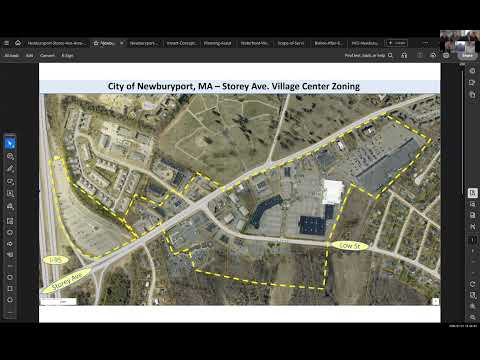
Resiliency committee flags water-supply ceiling as Story Avenue redevelopment advances
Summary
Planning staff told the Newburyport Resiliency Committee that citywide water limits, plant capacity and DEP permit thresholds mean Story Avenue and other growth areas must be planned against a firm supply "ceiling." Members urged drought buffers, modeling and coordination with the water division before rezoning or permitting new multifamily units.
The Planning director told the Newburyport Resiliency Committee that the city must set a practical ceiling on future residential growth to match water-supply limits and avoid permitting development the distribution and treatment system cannot support. "We set that as the ceiling, essentially," the director said while outlining three capacity thresholds: aquifer drawdown, plant output and the state (DEP) permit allowance.
Committee members said the ceiling should shape rezoning and permitting discussions around Story Avenue and the MBTA district. The director noted existing commitments that already consume capacity, including a Plaza Landings proposal of 212 units and the MBTA district allocation the presenter cited as about 1,292 units; accessory dwelling units were treated as rough placeholders in the exercise. He urged that land-use decisions be informed by water-division numbers so rezoning does not outpace supply.
Members asked technical questions about storage and treatment limits. One committee member summarized reservoir math used in preliminary checks: "We have 1,000,000,000 gallons [in the reservoirs] ... that came out to, I believe, 17" months of storage under an illustrative plant-flow assumption; with a hypothetical 3,000,000-gallons-per-day plant the same speaker noted the buffer could shrink to roughly 11 months. The group emphasized those were modeling inputs, not final engineering numbers.
Drought and emergency demands were central to the discussion. Members flagged firefighting demand (the speaker noted a fire hydrant can draw about 2,000 gallons per minute) and debated whether emergency water sources should be planned outside the watershed or supplemented with cisterns, irrigation wells or other measures. Some raised the Merrimack River as a potential emergency extraction point but also warned of saltwater intrusion and equipment corrosion.
On policy, the committee explored how to apply a drought buffer: as a citywide percentage ceiling (examples discussed ranged from 5% to 20%) or as per-project requirements that would require developers to demonstrate water savings or offsets. The Planning director suggested tying zoning allowances to a quantified ceiling informed by hydrologic modelling and water-division data so that zoning does not enable more cumulative usage than the city can support.
Follow-ups assigned at the meeting include a staff request to coordinate with Pete King in the water division, outreach to existing watershed consultants to assess drought-modeling expertise, and voluntary research into drought-case studies from other communities. Julia Godfersen volunteered to investigate modeling approaches used elsewhere. The committee did not adopt any formal policy or vote; members agreed to return with consultant recommendations and refined modeling inputs at a future meeting.
Next steps: staff will reconvene with water-division staff and identified consultants to produce a modeling scope that includes reservoir yield, plant output scenarios and firefighting/drought stress tests that the committee can use to translate a supply ceiling into zoning or permitting thresholds.