Get Full Government Meeting Transcripts, Videos, & Alerts Forever!
Get email alerts on the Resiliency Checklist topic
No spam. Unsubscribe anytime.
Committee considers embedding resiliency checklist in permit applications and OpenGov
Summary
The Newburyport Resiliency Committee discussed converting a voluntary resiliency checklist into an application-linked tool in OpenGov, aligning it with existing ordinances and adding simple automated prompts (flood-zone lookup) so boards have actionable criteria during permit review.
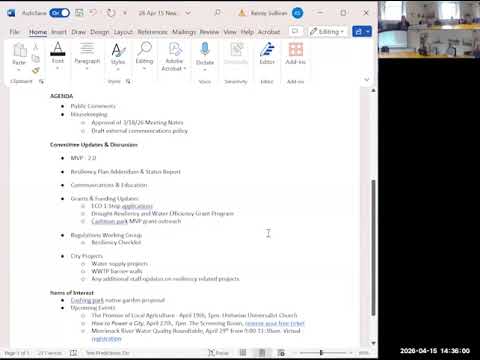
The Newburyport Resiliency Committee on an online meeting discussed making its resiliency checklist a formal part of permit application materials so planning and conservation boards can better evaluate development proposals.
Committee member (S3) said the checklist was originally conceived as a planning tool but argued it should be integrated into applications: "We had to make some tweaks to it, essentially making it part of the application form for folks." The discussion focused on balancing usability for applicants with the boards' need for consistent, reviewable criteria.
Members proposed embedding the checklist in OpenGov so applicant addresses can trigger automated checks such as flood-zone prompts. Committee member (S3) explained the automation could reduce paperwork and surface issues for boards sooner: "Once they put their address in, it reflects back to my map and it'll say to not flood them." Committee member (S6) said the group had debated whether the checklist would be strictly regulatory and recommended updating ordinances if the committee wants the answers to be required rather than optional.
Several participants supported developing a short explanatory statement and hyperlinks to code references so applicants understand whether the checklist is instructional or mandatory. The committee also favored producing a two-page "cheat sheet" with photographic examples and clear guidance to help applicants and board members interpret checklist responses.
The committee did not adopt formal regulations during the meeting. Members set a near-term work plan to: finalize action-item edits to the checklist, draft a short outreach two-pager, coordinate with the planning board and conservation commission on how the checklist would appear in OpenGov, and identify which ordinance language would need revision for the checklist to become a required application element. The group discussed aiming for fall implementation of any regulatory updates and embedding the checklist in the permit workflow as a next-phase objective.