Get Full Government Meeting Transcripts, Videos, & Alerts Forever!
Get email alerts on the Licensing topic
No spam. Unsubscribe anytime.
Neighbors and board spar over Lightning Society plan for 45 Howard Street; concerns on sound, traffic and safety
Summary
A tense Community Board 2 licensing hearing Wednesday focused on a proposal by the Center for Emerging Culture/Lightning Society to operate a catering venue on floors 2–3 and a private members club on floors 4–5 at 45 Howard Street. Supporters praised the cultural programming; opponents warned of noise, sidewalk congestion and unresolved Department of Buildings violations.
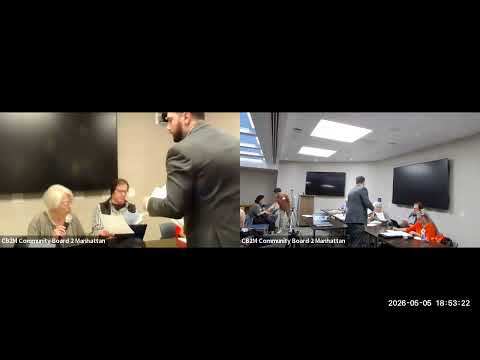
Community Board 2’s State Liquor Authority licensing committee spent more than three hours Wednesday re‑hearing the Center for Emerging Culture’s application to license multiple floors at 45 Howard Street, the building that the group proposes to operate as the Lightning Society cultural hub.
Donna Raftery, the committee chair, opened the meeting and directed applicants and the public to the board’s rules on speaker cards and respectful remarks. After a series of shorter applications, the discussion centered on the Center’s two applications: a beer‑and‑wine catering license for floors 2–3 and a not‑for‑profit private members’ club on floors 4–5.
The applicant team, led in the hearing by counsel Max Bookman and founder Timothy Phillips, described a split model: the downstairs ballroom/catering space for pre‑booked private events such as corporate receptions and book talks, and an upstairs membership club aimed at “salon”‑style programming and workspace. "We are not a nightclub," Bookman told the committee, and Phillips emphasized the intent that "these are two separate business models and there is no intention of operating this as one facility." The team said they hired consultants to produce a traffic and an acoustical operations study, and they offered a series of operational plans, including staffed queuing, staggered arrivals and an internal sound‑management system.
Supporters, including residents and regular Lightning Society participants, urged the board to back the application. "When I go to Lightning Society, I'm there to listen," said Adam Devine, a longtime attendee, arguing the space would draw a quieter, program‑oriented crowd rather than late‑night partygoers.
Opponents and nearby residents, backed by two licensed architects, pressed the applicant on safety, sound and neighborhood impacts. Architect Henry Smith Miller said he reviewed the plans and voiced particular concern about egress and occupancy, saying, "I don't think they'll ever get a certificate of occupancy," and calling the proposed numbers and stair configuration unsafe. Resident Marie Dormo argued bluntly that "this building is not appropriate for this use," citing single‑pane skylights, historic construction, and the risk of vibration and fire spread.
Traffic and crowd management were recurring themes. The applicant's traffic planner, Kevin Williams of the consulting team, said the operation would direct drop‑offs toward Broadway and use staff to manage curbside flow; "we will direct the address for drop‑offs to be on Broadway," he said, and described staged staffing levels for larger events. Neighbors disputed that the Broadway curb could absorb frequent, large drop‑off flows, citing heavy bus and subway usage and narrow sidewalks.
Residents also recounted recent on‑site activity they said predated approvals and contributed to mistrust. Several speakers told the committee they had documented loud social events and ad‑hoc activations at the building in recent months, and urged the board to treat the current plans skeptically until Department of Buildings (DOB) and code issues are resolved. The applicant acknowledged open stop‑work orders and other DOB filings and said those matters were being addressed as "misunderstandings with DOB inspectors," adding they did not represent life‑safety problems.
Committee members pressed for enforceable mitigations. Near the meeting's close, the applicant agreed to a set of operational concessions as a show of good faith: no amplified speakers on the rooftop, windows kept closed during events, staffing and queuing protocols tied to the traffic plan, reliance on the submitted sound and traffic studies and limits on late‑night operations. The committee also discussed—without taking a final vote—limits on very large events and on simultaneous large events across licensed floors.
What happens next: the committee debated and recorded concerns and recommended conditions for any SLA review. Because several significant DOB, occupancy and egress questions remain unresolved in the record, neighbors said they expect to continue to press the applicant and the liquor authority for stricter, enforceable stipulations. The committee moved the matter into business session to consider a formal recommendation to the SLA.
The licensing review in Community Board 2 is only one step: the SLA and the Department of Buildings retain authority to grant or deny permits and to require changes. The applicant said it will continue outreach and refinement of its mitigation measures; neighbors said enforcement of DOB requirements and robust, verifiable sound and traffic protections are prerequisites to their support.
Ending — next steps and context The committee did not issue a final approval; it signaled it would weigh a package of operational stipulations and continue to press the applicant and the SLA for clarity on DOB status, final occupancy determinations and enforceable noise and traffic controls. The SLA hearing date had not been resolved in the transcript record; neighbors were advised to monitor DOB and SLA filings for follow‑up.