Get Full Government Meeting Transcripts, Videos, & Alerts Forever!
Get email alerts on the Municipal Finance topic
No spam. Unsubscribe anytime.
Falmouth finance committee reviews long-range forecast showing possible 2028 deficit
Summary
Finance staff presented a long-range forecast to the Town of Falmouth Finance Committee showing a projected $1.4 million operating shortfall in 2028 and larger gaps thereafter driven largely by inflation, rising pension and health-care costs; staff recommended community outreach and policy choices including a $15M free-cash target, spending reductions, or overrides.
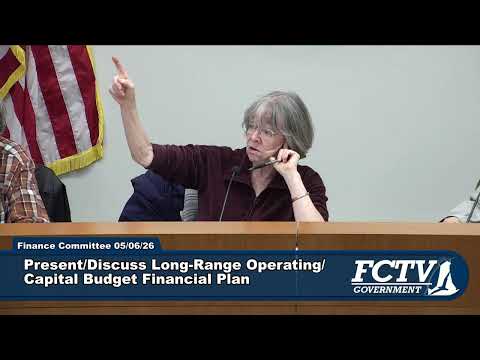
The Town of Falmouth Finance Committee on May 6 heard its first comprehensive long-range financial forecast, and staff warned the town could face an operating deficit of roughly $1.4 million in 2028 that grows in later years without policy changes.
Laura, the presentation lead, said the model used the FY27 operating budget and a November 2025 10-year capital improvement plan to build category-level projections and then applied inflation factors and scheduled pension increases. "When you put all this together, what you get is in 2028, we have right now a projected deficit of $1,400,000," Laura said during her presentation.
The forecast reports debt as annual service (principal and interest), not total principal outstanding. Laura also proposed a free-cash policy for capital: "We set up potential free cash ceiling of $15,000,000 ... we're going to propose that there be a free cash policy that says whatever certified free cash we have, $5,000,000 of it should be held until the April town meeting," she said, noting that would require about $20,000,000 in certified free cash to fund $15,000,000 of free-cash capital.
Committee members pressed staff on drivers of the gap. Several members noted inflation is a key factor but not the only one; pension contributions and health-care costs are rising independently of general inflation. Laura said she used conservative assumptions—for example, an 8% annual assumption for health insurance and retirement increases—and that changing those factors materially alters long-term costs.
Town Manager (name not provided) said staff will take the forecast and scenarios to the public and solicit input on trade-offs. "We're going to take this out to the community," the Town Manager said, outlining plans for at least three community meetings to show different scenarios and tax impacts.
Finance Committee member Mary stressed the legal constraint on balanced budgets and the need for public input: "Every year by law, we're required to have a balanced budget. So if we get to next year and we have done nothing, we do have to reduce expenses," she said, urging community discussion about what services residents want funded.
Public comment underscored urgency. Joe Neto, a town meeting member from Precinct 9, told the committee he could not support new debt for capital projects until the operating deficit question is addressed: "I could not go into a voting booth and conscientiously vote for any project that is going to incur more debt ... without having an answer of how we are going to solve the operating budget." He urged staff to make outreach personal, for example by asking attendees to bring their tax bills so they can see household impacts.
On capital, the presentation included a list of potential projects from the 10-year CIP: an East Falmouth library ($6 million assumed in the plan), a police station (modeled at roughly $60 million), and a placeholder $150 million figure for a Lawrence School project (Laura said that figure is a placeholder and was not reduced in the model for the possible 38.5% state school construction reimbursement). Laura noted some wastewater projects include subsidies (for example, Clean Water Trust support) that staff incorporated where known.
Staff showed combined projections that fold operating deficits, annual debt-service estimates and free-cash-funded capital together. Under one model that assumed select exempt debt and a 1.5% wastewater improvement fund, the combined 2028 shortfall was modeled at about $4.7 million; applying a $15 million target for free-cash-funded capital reduced a modeled deficit to roughly $1.6 million in the example shown.
Committee members and staff discussed options the town can pursue: reduce operating expenditures; adopt a free-cash policy and preserve a portion of certified free cash; plan for targeted debt exclusions (voter-approved excluded debt) for specific large projects; or pursue a voter-approved operating override. Staff also described short-term cost-control steps already taken, including a soft hiring freeze and reviews of newly vacant positions.
Next steps include public education and outreach to present scenarios and tax impacts ahead of town meeting. The committee set a calendar: capital-review meetings beginning Aug. 19 with an early town meeting expected Oct. 26. The meeting adjourned after public comment and scheduling remarks.
The presentation and subsequent discussion do not represent final policy decisions; the forecast is a tool for committee and select board deliberations, and staff emphasized many assumptions (timing of projects, reimbursement amounts and inflation rates) can change the modeled outcomes.