Get Full Government Meeting Transcripts, Videos, & Alerts Forever!
Get email alerts on the Technology topic
No spam. Unsubscribe anytime.
Huntsville City Schools details AI tools, $6.3 million curriculum projection and network upgrades in technology briefing
Summary
District technology leaders told the board March 10 that AI tools and classroom platforms are expanding districtwide, outlined a projected $6.3 million curriculum adoption cost this year tied to social-studies materials, and described infrastructure and cybersecurity upgrades including cellular backup for VoIP and layered student filtering.
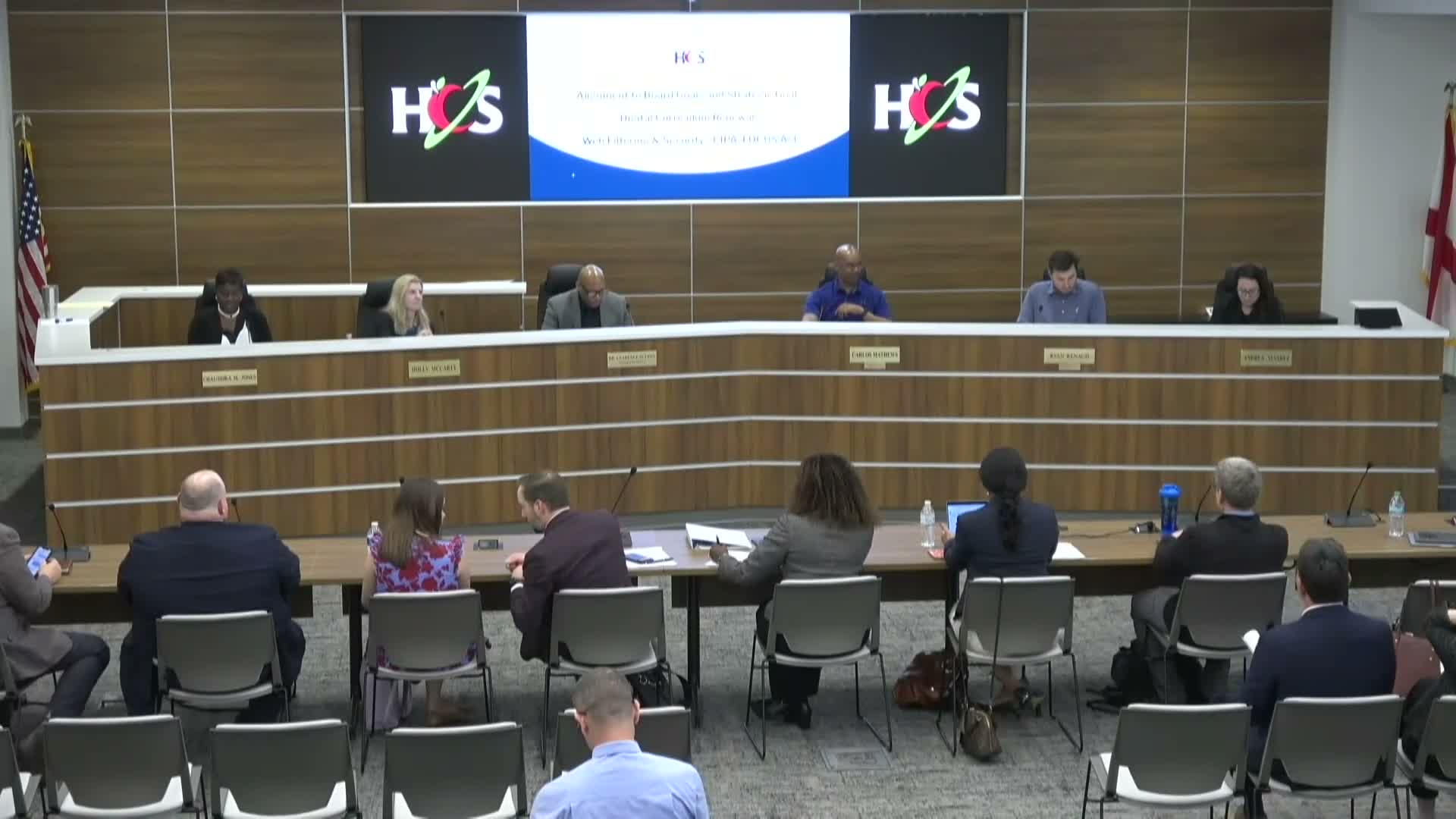
Miss Elam, the district's technology presenter, told the Huntsville City Schools board during the March 10 work session that the district has expanded AI-supported instructional tools and is aligning technology efforts with the district strategic plan.
“We have Magic School…we had over a 150,000 generations in Magic School this school year alone,” Miss Elam said, describing the district’s AI classroom tools and their use for writing feedback, tutoring and character chat bots. She said Magic School provides classroom guardrails so teachers can shape how AI responds to students.
Elam also presented the district’s current digital-curriculum budget projection: “We have a projected cost for elementary of 1,500,000, middle school, 850,000, and high school is 4,000,000,” and said the higher total—about $6,300,000—was driven by a social-studies adoption year and remains subject to final quote adjustments.
Board members pressed for clarity on evaluation and procurement. A board member asked whether the district will discontinue underused applications once usage data are available; Elam said the district is participating in a state pilot of Learn Platform to link platform usage to student outcomes and that priority and removal decisions will be informed by that data. “Learn Platform…looks at actual usage of our platforms and they also provide us with data analysts to take that usage data and compare it to achievement and growth,” she said.
On infrastructure, Elam listed device and network inventories—675 switches, nearly 3,000 access points and roughly 2,700 VoIP phones—and outlined cybersecurity and redundancy steps. When a board member asked about VoIP redundancy during Internet outages, she said the district “just this week installed cellular cradle points in the high schools so that we have cellular backup” and is working to extend that backup to additional schools.
Elam described the district’s layered student-safety and filtering approach: device-level filtering (GoGuardian) that travels with student Chromebooks, classroom-level controls teachers can apply, and a DNS filter for cybersecurity. She also described a human-reviewed safety-monitoring system that flags possible suicide or serious-threat indicators for further human assessment, and listed other cyber-defenses—multi-factor authentication, phishing-test campaigns and endpoint security—that qualify the district for state cybersecurity grant funding.
School leaders flagged limits the state Focus Act places on chat and social-media features in student-facing platforms, an issue that affects extracurricular e-gaming competitions that include chat functions. Elam said some game chat features cannot be enabled without violating the law or district policy and recommended legal review and possible legislative engagement to address narrow extracurricular exceptions if desired.
Why it matters: The technology briefing combined classroom instructional choices, procurement costs and security posture in one presentation, giving board members both near-term budget figures and a roadmap for vendor-evaluation using pilot analytics. The district plans to use Learn Platform analytics before making substantive removal or renewal decisions for digital tools and to expand cellular redundancy to reduce communication outages in schools.
Next steps: Final curriculum quotes and adoption decisions are pending; the district will continue the Learn Platform pilot this school year and follow up on hardware-quote details and additional redundancy rollouts.