Get Full Government Meeting Transcripts, Videos, & Alerts Forever!
Get email alerts on the Camera Policy topic
No spam. Unsubscribe anytime.
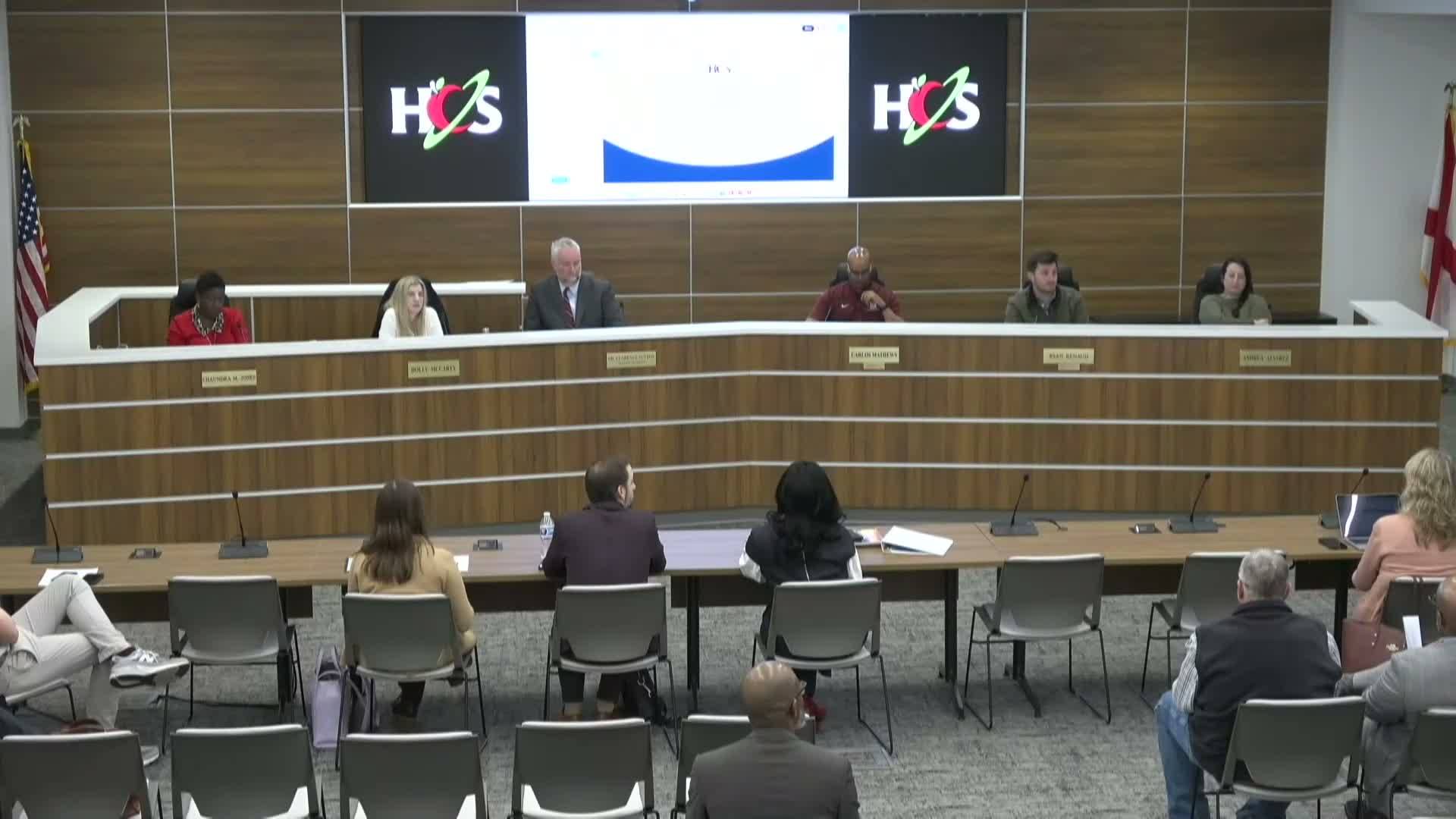
Board adopts policy to place cameras in resource classrooms under Tyler’s Law
Summary
The Huntsville City Schools board approved a policy to install and manage audio/video cameras in resource (self-contained) classrooms under Alabama Code 16-39-13 (Tyler’s Law); recordings will be retained at least three months, access will be limited, and the district reported 22 of 76 cameras installed but not yet operational.
The Huntsville City Schools Board of Education on Tuesday approved Policy 4.2 to implement Alabama Code 16-39-13, commonly known as Tyler’s Law, authorizing audio and video cameras in resource (self-contained) classrooms.
Dr. Smith, presenting the policy, said the cameras "will record both video and audio during school hours and at any time a student is present in the resource classroom," and that recordings "will be retained for a period of 3 months" with an extension when that period overlaps a school break. The policy defines a resource classroom as one in which at least half the students regularly receive special education services and applies to attached calm-down or sensory rooms.
The policy requires that recordings be treated as confidential and limits routine access: relevant portions may be viewed when an incident is reported to the superintendent or principal, by employees involved in the incident, the parent or guardian of a student documented in the recording, investigators, legal counsel for listed individuals, and law enforcement when consistent with FERPA and state law. Dr. Smith said the board "will take precautions to conceal the identity of any student" not involved in an incident, including blurring faces when appropriate.
A district staff member noted storage and operational status: "To date, 40% of the cameras are installed. None of them are currently operational, and that 40% is about 22 out of 76 classrooms." In response to board questions about retaining footage beyond the statutory minimum, a staff member familiar with the law said it "would be allowable to go beyond the 3 months," but warned that additional storage raises cost and administrative considerations.
Board members raised several procedural and privacy questions during discussion. One member asked how the district will ensure cameras are functioning; the operations team said technicians and a control-room monitoring function exist and that staff could provide a daily online/offline log if the board requests it. Another board member pressed whether footage could be used for individualized education plan (IEP) decisions; legal/staff presenters said Tyler’s Law and the presented policy do not authorize routine use of footage for IEP determinations and cautioned that such uses may be outside the law’s intent.
The board moved to adopt the cameras policy and the motion passed. The policy authorizes the superintendent to implement procedures consistent with the policy, including methods for requesting access to footage and for ensuring compliance with FERPA and state law.
The board’s action followed the presentation and questions; the policy will be implemented by district staff and the superintendent’s office.