Get Full Government Meeting Transcripts, Videos, & Alerts Forever!
Get email alerts on the Education Strategic Planning topic
No spam. Unsubscribe anytime.
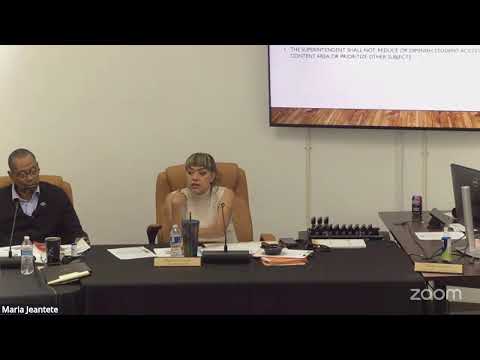
Taos board reviews draft 3‑year goals, proposes guardrails and schedules May 14 community input session
Summary
At a May 4 work session, consultants presented district assessment data and draft SMART goals that would use 2024–25 as the baseline and seek a cumulative 15‑point proficiency gain by 2028–29; the board prioritized three guardrails (community engagement before major decisions, whole‑child supports, and college/career readiness) and set a May 14 community meeting to solicit public input.
Consultant David Chavez told the Taos Municipal Schools Board of Education on May 4 that draft, three‑year SMART goals for English language arts and mathematics would use district assessment data and short‑cycle monitoring to measure progress, and recommended using 2024–25 as the baseline year. "Beginning with the 2026–27 school year to the 2028–29 school year, Taos Municipal School District will increase the percentage of students scoring proficient or above in mathematics on the New Mexico State Assessment by a cumulative 15 percentage points," Chavez read aloud during the presentation, adding that the board should rely on shorter cycle assessments to track interim progress.
The board spent most of the special meeting focused on those draft goals and on selecting 3–5 "guardrails" — board-level constraints meant to protect the goals while leaving implementation authority with the superintendent. Chavez and CES coach Billy May Ortiz presented sample guardrails harvested from other New Mexico districts (Socorro, Roswell and Ruidoso) and said the consultants used the board’s vision, mission and core values to generate AI‑draft guardrail language for the board to refine.
Why it matters: The proposed goals and guardrails would shape district action plans, budgeting and monitoring over the next three years. Board members emphasized that clear, measurable guardrails will be necessary for transparent progress monitoring and for protecting services and opportunities for particular student groups.
What the data shows: Chavez summarized recent NMSA and SAT results compiled for the district, noting Taos’s ELA proficiency rose to roughly the mid‑40s percent in 2024–25, and mathematics performance has been lower and more variable. He described AIS (American Alliance for Innovative Systems), the consulting group supporting math interventions and professional development across participating districts, and said districts that implement AIS with fidelity have seen gains. "For those districts implementing [AIS] to fidelity, it is making a difference," Chavez said.
Board discussion and guardrail priorities: Board members debated phrasing and content. Several members favored combining language from Socorro and Ruidoso to require engagement with students, parents, staff and the community before the superintendent brings major programmatic or resource‑allocation decisions to the board. Members also pushed to include a guardrail addressing whole‑child supports and social‑emotional learning and another that explicitly links coursework and experiences to college and career readiness.
Process and community input: The board agreed to hold a community input meeting on Thursday, May 14, to gather public priorities and to test the draft language. Chavez said he would prepare a short public‑service announcement, a template invitation for the board to distribute, and a cleaned‑up draft of goals and guardrails after the meeting. Board members discussed logistics for the May 14 forum (cafeteria or similar school site preferred to allow small‑group table work), the use of roundtables or stations, RSVP requests to estimate attendance, and limited refreshments.
Formal action taken: The only formal vote recorded during the session was approval of the meeting agenda at the outset. Vice President Sprague moved to approve the agenda; the motion was seconded and recorded as adopted by roll call (King: yes; Sprague: yes; Flores: yes).
What’s next: Consultants will return a cleaned, concise version of the goals and multiple guardrail wording options following the community meeting. The board will review those edits in a future work session before finalizing the strategic plan and the monitoring metrics. The next regular board meeting is scheduled for May 6, 2026, at 6 p.m.; President Flores said he would attend virtually and Vice President Sprague would preside.