Get Full Government Meeting Transcripts, Videos, & Alerts Forever!
Get email alerts on the Rails With Trails Project topic
No spam. Unsubscribe anytime.
San Buenaventura updates design for Santa Paula Branch Line ‘rails-with-trails,’ shifts alignment near Saticoy
Summary
City and VCTC staff presented a 90% design update for the four-mile Ventura segment of the Santa Paula Branch Line rails-with-trails project, announced an alignment shift to the south between Pettit and Saticoy to reduce grading and utility conflicts, outlined safety measures and a construction timeline targeting late 2025–2026.
San Buenaventura city staff and Ventura County Transportation Commission officials on the evening update described progress on the Santa Paula Branch Line rails-with-trails project and a key design change that moves part of the trail from the north to the south side of the railroad between Pettit and Saticoy.
Alex Puga, senior transportation engineer and the city’s project manager, opened the public outreach meeting and said the city is leading design and will post a Q&A after the session. Eric Berg, principal landscape architect at Pacific Coast Land Design, told attendees the Ventura segment is at about 90% design and the team aims to begin construction in late 2025 with the trail opening targeted for mid‑2027.
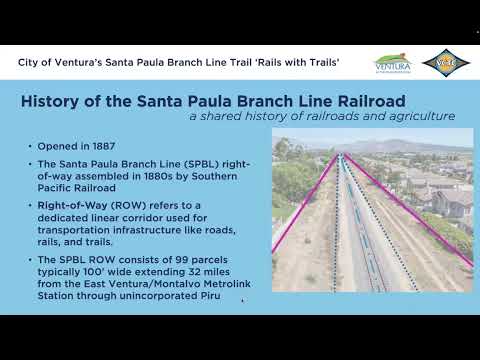
The project covers roughly four miles in the city and will link the western end at the Montalvo Metrolink station to the Saticoy area on the east, with trailheads, bridges, traffic-signal improvements, lighting and other amenities planned. Amanda Fagan, director of planning and sustainability at the Ventura County Transportation Commission (VCTC), described the corridor’s history and presented VCTC projections that full buildout could reduce vehicle miles traveled by an estimated 23,000–46,000 miles daily and support about 300–500 daily bike trips, with an estimated $2–7 million in annual economic benefit.
A notable design revision announced at the meeting moves the alignment between Pettit and Saticoy from the north side of the rail to the south side, Berg said. He described the change as driven primarily by cost savings — eliminating extensive grading and many retaining walls on the north side — and by fewer conflicts with utilities and private-property impacts. That southern alignment will require a new bridge across a drainage channel as a tradeoff, Berg said, but the project team concluded the bridge cost is outweighed by the reduced grading and utility work.
‘We have reduced potential impact to private properties along the north side because of the grading conditions,’ Berg said, adding that houseshielded lighting and other mitigation would limit visibility and light impacts on adjacent homes.
Design and safety features discussed in detail include a signalized crossing at Johnson Drive built to FHWA traffic-control standards, a HAWK system proposed for Bristol Road to address geometric sight-line issues, a two-way protected cycle track at Wells Road, emergency-vehicle access points, clear sight-line standards, and placement of security call boxes. Commander Ryan Weekes of the Ventura Police Department described camera and patrol plans, saying the city’s CCTV feeds are accessible to dispatch and the watch commander and that the department will conduct ‘‘focus patrols’’ on the path when it opens. ‘If you see anything, please call. If you're not comfortable dialing 911, our non-emergency number is 805‑650‑8100,’ Weekes said.
City communications staff also reviewed resources for non-urgent community needs and trespassing responses. Alejandra Bell Alcazar said the tracks and land around them are private property and called trespassing unsafe, and she encouraged use of community services such as calling 211 for shelter referrals and the Ventura Connects app for maintenance reports.
The project’s funding picture was described as split by phase: the presentation referenced ATP (Active Transportation Program) Cycle 6 funding for design and other regional funds for construction. Berg said the team expects to complete final design in late 2025 and proceed to construction thereafter. Staff urged residents to review materials posted on the city’s project webpage and to attend the scheduled in-person meeting on May 8 at Jupiter Oser Elementary School for more detailed conversation with design staff.
The city plans to post answers to questions submitted during the meeting on the project website and to continue stakeholder engagement as the design is finalized.