Get Full Government Meeting Transcripts, Videos, & Alerts Forever!
Get email alerts on the Bridge Replacement topic
No spam. Unsubscribe anytime.
San Buenaventura outlines plan to replace Main Street Bridge while keeping pedestrian and bike access
Summary
City staff and consultants presented a staged replacement of the Main Street Bridge to address scour risk, preserve pedestrian and bicycle crossings during construction, and begin an Environmental Impact Report alongside a NEPA assessment with public comment opportunities this fall.
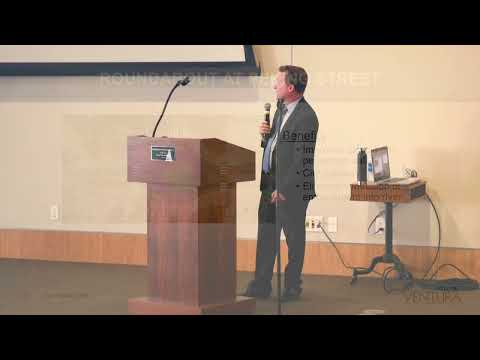
City of San Buenaventura engineers and their consultants presented plans to replace the Main Street Bridge at a public meeting, saying the structure is scour‑critical and requires full replacement and environmental review. Jeff Herford, principal civil engineer for the City of Ventura, said, “This is the initial phase of the project. It’s mostly the environmental part. We’re also doing some design on this which will inform the environmental.”
The project team emphasized that design choices will preserve pedestrian and bicycle access through staged construction and that the City will prepare an Environmental Impact Report (EIR) under the California Environmental Quality Act while Caltrans will lead a National Environmental Policy Act assessment if federal funding is involved. “The city has decided that they’re going to prepare an environmental impact report,” said Aaron Silva, environmental planner and subconsultant to the City.
Heritage and safety background, and the reason for replacement Jeff Herford reviewed the bridge’s history — originally completed in 1913, with major reconstructions in subsequent decades — and described recent inspections that label the bridge scour‑critical. He said Caltrans inspects city bridges and has flagged the structure; city staff concluded replacement is the appropriate countermeasure rather than incremental repairs.
Design and construction staging to preserve access Dan Wedell of HDR, the project’s lead bridge engineer, described preliminary design choices intended to keep the new bridge within existing right‑of‑way and to maintain multimodal access. Wedell described a two‑stage construction sequence: build one side while keeping pedestrians and bicycles on the opposite side, then shift traffic and reconstruct the remaining span the following season. “We’ll always maintain pedestrians, bikes, and vehicles,” Wedell said. During staging, vehicles would be limited to a single alternating lane controlled by temporary signals to prioritize local access and avoid long detours to U.S. 101.
Planned cross‑section and public‑realm features The proposed cross section calls for wider sidewalks and dedicated bicycle facilities: the north sidewalk will be widened to a 6‑foot standard in many locations, a 5‑foot shoulder is included for dual vehicle/bike use, and a barrier‑separated two‑way bikeway on the south side would be widened from 10 to 12 feet. The design includes an 18‑foot belvedere (midspan pop‑out) to support seating, public art and river viewing; typical sidewalks are shown at 8 feet outside of that expanded area.
Intersection, hydraulics and local connections Wedell said the east end will include a roundabout at P King Street to slow traffic and shorten crosswalk distances, and that design decisions avoid placing abutments farther into the river, which would increase flow speeds and lower surface water. The bridge provides key local connections to the RV park, Taylor Ranch and Emma Woods, and offers an alternate emergency route to U.S. 101 when the main 101 crossing is compromised.
Environmental review and public engagement timeline Aaron Silva outlined the regulatory framework and next steps. The City will be the CEQA lead agency and prepare an EIR; Caltrans will be the NEPA lead for federal review. Silva said the team is preparing a Notice of Preparation (to be filed with the State Clearinghouse) and expects workshops in the fall focused on design, with draft environmental documents circulated for public comment for approximately 30–45 days. Coastal permitting under the California Coastal Act will follow its own public process. Silva encouraged attendees to sign up for updates, use the project website (QR code provided), and submit comments when draft documents are released.
What happens next No formal actions or votes were taken at the meeting. The City and consultants said they are in the Notice of Preparation phase: technical studies are underway, design will continue to be refined, public workshops are planned this fall, and formal comment periods for the draft EIR/EA will follow. Staff and technical specialists, including a biologist, remained after the presentation to answer individual questions.
Ending The presentation closed with staff inviting attendees to meet in the back of the room for follow‑up questions and to sign up for project updates and document circulation.