Get Full Government Meeting Transcripts, Videos, & Alerts Forever!
Get email alerts on the Zoning Public Safety topic
No spam. Unsubscribe anytime.
Seaside planning commission backs code change to let contracted ambulance bases seek public-safety use permits
Summary
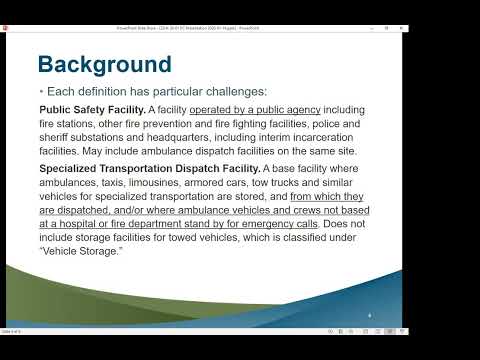
The Seaside Planning Commission recommended a zoning amendment to redefine "public safety facility" so facilities contracted by public agencies — such as an AMR ambulance base — can apply for a use permit; commissioners and staff said the change does not convey special benefits and applications will follow usual review and appeal processes.
The Seaside Planning Commission on its regular meeting voted to recommend a zoning ordinance amendment that would redefine "public safety facility" to explicitly allow facilities operated under contract to public agencies, such as a proposed AMR Medical Services ambulance base, to apply for a use permit.
Staff presented the change as a targeted, administrative fix to clarify how the code treats facilities that are not directly operated by a government agency. A staff member described the proposal as "a very narrow amendment" intended to let contracted providers submit applications under a public-safety definition rather than having their proposals be treated as prohibited uses because no existing definition fits.
Resident Robert Wood questioned whether reclassifying a private company site as a public-safety location would convey special advantages. "What benefits does it accrue in terms of the status as far as use of the property, or what's the purpose besides just calling it a public safety location?" Wood asked during public comment.
The staff member responded that "there are no special benefits being conveyed here" by the code change. The amendment would allow applicants to submit a use-permit application and would not bypass normal permit review, notification or appeal procedures. The staff member added that where an application is submitted it will be evaluated "just like everybody else" and processed as a use permit; whether the matter comes before the planning commission depends on notice and appeal thresholds.
Commissioners asked technical questions about whether the site would include a building and where ambulances would be stored; staff confirmed there is a building for supplies and ambulances would be parked on site. The mover said he supported adopting the resolution as written with the minor wording tweak discussed during the meeting (adding "and/or" to capture jointly operated or contracted arrangements). Another commissioner seconded the motion and the commission approved the resolution recommending the ordinance amendment to the City Council with no recorded dissent.
What happens next: The commission's action is a recommendation; the City Council will receive the proposed ordinance amendment and take any final action. If an operator later files an application, it will be evaluated under the clarified code and processed through the usual permitting, public-notice and appeal channels.