Get Full Government Meeting Transcripts, Videos, & Alerts Forever!
Get email alerts on the County Budget topic
No spam. Unsubscribe anytime.
Richmond County presents FY27 recommended budget with no tax-rate change; proposes 2% raise and flags 12% insurance hike
Summary
The county presenter outlined a balanced FY27 recommended budget with no change to property or personal property tax rates, proposed a 2% raise for full-time county staff effective July 1, 2026, and warned of a roughly 12% rise in health insurance premiums that will pressure departmental budgets.
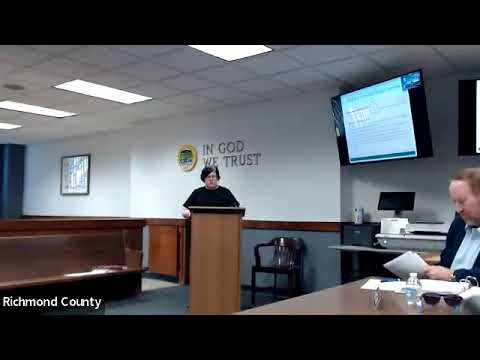
The Richmond County Board of Supervisors heard a presentation on the recommended FY27 budget that keeps existing tax rates unchanged while proposing targeted employee pay increases and flagging rising insurance costs.
The presenter opened the meeting by distributing the recommended budget, the line-by-line document and department requests, and thanked department heads and staff who helped compile salary and insurance figures. "Our priorities include maintaining strong public safety services, supporting our schools, maintaining infrastructure, and investing in programs that contribute to the quality of life in Richmond County," she said.
On taxes, the presenter recommended no change for FY27: 60 cents per $100 of assessed real estate, $3.50 per $100 of personal property, 40 cents per $100 for machinery and tools, and $3.50 per $100 for merchants' capital. Vehicle license fees were also left unchanged.
The budget presentation models a 2% raise for all full-time county staff effective July 1, 2026, based on a state-funded increase that localities are incorporating. The presenter said health insurance premiums are expected to rise about 12%, and that the budget reflects a combination of modest offsets (a lower VRS contribution rate) and built-in adjustments to keep plans affordable for single and family coverage.
Education remains the largest share of county spending; the presenter said Richmond County Public School would represent about 60.6% of the budget and 64.14% when county-paid school debt service is included. The schools are proposing a 3% raise for eligible employees and also face the county's 12% insurance increase.
Department-specific changes include modest increases in IT professional services (about $12,000) to support CAD/RMS systems, a $10,000 addition for computer equipment for sheriff vehicle replacements, and a roughly $6,300 increase to juvenile detention based on a five-year rolling average. The sheriff's office saw a $31,000 increase categorized with machinery and equipment (the presenter said that reflects Axon membership costs).
The presenter proposed increasing the ambulance fund by $25,000 this year with the aim of reaching a $100,000 annual contribution in future years to better time vehicle purchases and reduce borrowing. Several board members pressed to accelerate that target immediately, citing rising call volumes and heavy vehicle use.
On outside funding, the recommended budget partially funds several nonprofits but reduces or holds flat some requests; Healthy Harvest was recommended at $8,500 of a $10,000 ask, the Boys & Girls Club was recommended at $8,500 of a $15,000 ask, and a $5,000 guest shelter request was left unfunded pending further discussion.
The presenter said revenue projections include an assumed $10 million in added real estate value used conservatively in FY27 calculations and noted the county will continue to review personal property tax relief levels (historically 50% relief was used; a return toward roughly 40% relief is anticipated pending billing updates). The FY27 budget also assumes $362,600 in revenue-share payments from planned solar projects, an increase from FY26.
Board members asked for follow-up data and raised concerns about decreasing the CIP contribution (the presenter said anticipated solar revenue would offset one-time projects but promised a CIP list for the April 9 work session). The presenter also noted a budget work session and the regular meeting scheduled for April 9 as the next steps.
The board did not take formal votes during the presentation; members agreed to review the materials and revisit items at the work session and subsequent meetings.