Get email alerts on the Education Curriculum topic
No spam. Unsubscribe anytime.
Millis School Committee approves changes to high school program of studies
Summary
The Millis School Committee unanimously approved semesterized course additions — including zoology, conservation biology, musical-theater history electives, and new business classes — and a proposal to increase credit for year-long academic-support courses to better reflect instructional time, pending enrollment and staffing.
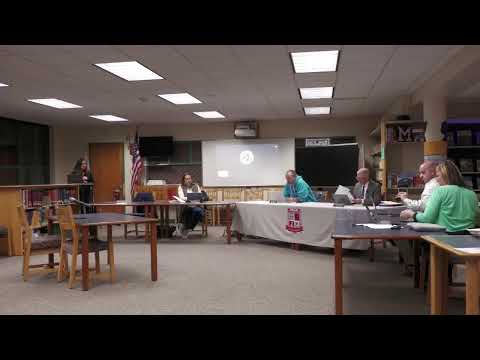
The Millis School Committee voted March 24 to adopt proposed changes to the high school program of studies, adding semester courses and adjusting credit to better reflect year-long instructional work.
Mr. Nash, who presented the proposals, said the new offerings are intended to expand student choice and better match student interest and local staffing capacity. “You’ll notice that our new course proposals are semester classes,” he said, explaining the scheduling flexibility this provides so students can pursue, for example, both a zoology class and a business elective across the year.
The committee approved two new science electives described as zoology and conservation biology, two sequential semester electives focused on drama and musical theater, and a pair of business-oriented semester courses (intro to business and advertising/marketing). Nash also proposed clarifying the labeling of environmental science as a specific course and moving a science curricular-development/instructional-methods offering to become a junior/senior-level course.
In addition, Nash recommended increasing the credited value for an academic-support course (previously given partial credit at lower levels) to five credits to align credit with the instructional time and rigor of a year-long program. He described the change as an equity adjustment so students receive credit commensurate with the course scope.
Committee members asked about enrollment thresholds and staffing; Nash and other staff emphasized that implementation depends on sufficient student interest and available staff. Miss Bartley and other presenters noted growing student demand for DECA and business programming, which informed the intro-to-business proposal. The committee moved and seconded the program-of-studies changes and voted to approve them unanimously.
The superintendent and staff will proceed with scheduling and staffing discussions and will bring implementation details back to the committee as course enrollment numbers become clearer.
AI generated
The text on this page is AI generated. Summaries, highlights, analysis, and video transcripts are all produced from the original source material.
AI can make mistakes, so if you spot one, and we will fix it for everyone.
Note: the source content is unaltered by us. Any content source we link to, be it a video, an audio recording, or a document, is presented exactly as its publisher released it. That publisher is usually a government body, sometimes an individual official or another organisation.