Get Full Government Meeting Transcripts, Videos, & Alerts Forever!
Get email alerts on the Local History topic
No spam. Unsubscribe anytime.
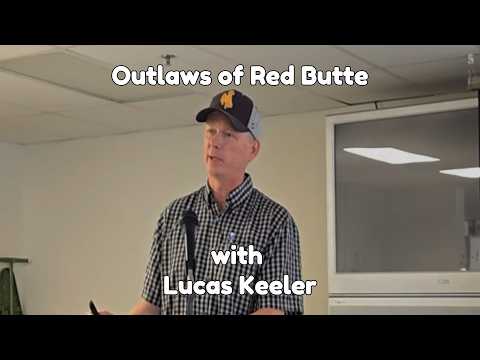
Local historian Lucas Keeler recounts 1889 shooting at Von Rippon dugout and ties to the Sundance Kid
Summary
At a Weston County Historical Society program, Lucas Keeler reviewed archival coroner's records and witness testimony he says show Buck Hamby (alias Bob Miner) was shot during an 1889 arrest at the Von Rippon dugout; Keeler also tied those events to Harry Longbaugh (the Sundance Kid) and described related homestead and court records.
Lucas Keeler, a local researcher and historian, told attendees at a Weston County Historical Society program that archival coroner's records and witness testimony indicate Buck Hamby (also known in records as Bob Miner) was shot by law enforcement during an arrest attempt at Arthur Von Rippon's dugout in May 1889.
Keeler said the coroner's inquest and contemporary newspaper accounts describe Sheriff James Swisher and Deputy Armstrong approaching the Von Rippon hideout at Salt Creek and Red Butte on May 13–14, 1889, and encountering Harry Longbaugh and others. Keeler summarized the inquest account: “They shot him in the back,” and later quoted Longbaugh’s testimony as saying Hamby was “just flat was shot by the authorities.” These are Keeler’s characterizations of the archival testimony and coroner’s file Keeler located at the state archives in Cheyenne.
Why it matters: Keeler framed the episode as a local nexus connecting rustling, cross-border fugitives and the early career of Longbaugh (the figure later known as the Sundance Kid). He said the material includes Longbaugh’s signed testimony and diagrams from the inquest that show the layout of the dugout where the encounter occurred. Keeler told the audience he plans to pursue moving the signature and related items to the state museum so they are preserved and accessible.
Keeler traced the backstory: he described a period in 1888–89 when horse-rustling prompted a string of $500 rewards in the Sundance Gazette, and related the sequence in which Bob Miner (born in Pennsylvania and later recorded in Kansas) adopted the alias Buck Hamby after an escape from custody and return to the Von Rippon ranch. Keeler said newspapers, telegrams and arrest records show cross-jurisdictional efforts to return Miner/Hamby to Kansas on murder charges and to hold suspects on horse-stealing counts.
Keeler also outlined conflicting accounts recorded in the archival file. He said Von Rippon wrote letters and an autopsy description asserting that Hamby resisted arrest, while Longbaugh’s testimony — as preserved in the coroner’s inquest — portrays the shooting as an unlawful killing. Keeler emphasized both documents exist in the archives: “He just flat was shot by the authorities,” Keeler said summarizing Longbaugh’s complaint in the file.
Keeler walked the audience through homestead and legal records he examined: an attempted homestead filing by Arthur C. Von Rippon that Keeler did not find proven up in the National Archives; later homesteading of the same legal parcel by George Getchell (c. 1906); and a later suit in 1890–91 in which Von Rippon unsuccessfully sued Newcastle for about $25,000 over water rights from Pisgah. Keeler said some local coroner’s files remain incomplete at the county courthouse and that many deeper records are held at the state archives in Cheyenne.
Audience members asked about the origin of Longbaugh’s nickname and escape stories; Keeler summarized the commonly reported transport-escape episode in which Longbaugh slipped from custody while being moved by train. Keeler closed by offering copies of his books for sale and noting plans for a second book on the Wagner murder; the moderator announced door-prize winners and upcoming field trips to Beavercreek and Custer State Park.
Keeler framed his presentation as archival reconstruction rather than as a new legal finding; he repeatedly cited archival sources (coroner's inquest files, newspaper accounts and homestead paperwork) and urged preservation of the materials he discussed. The program concluded with a short audience Q&A and the moderator's housekeeping announcements.