Get Full Government Meeting Transcripts, Videos, & Alerts Forever!
Get email alerts on the Land Use Zoning topic
No spam. Unsubscribe anytime.
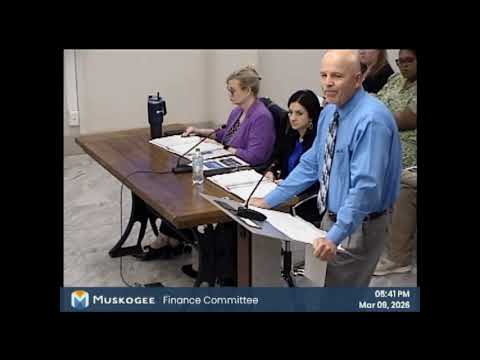
Muskogee staff outline R1/R5 zoning overhaul; council directs planners to pursue 'Plan B'
Summary
City planning staff detailed two options to reclassify R5 housing and allow tiny homes, manufactured/modular homes and RV parks under new rules; council indicated support for Solution B and asked planning commission to review before a final vote.
City of Muskogee planning staff presented proposed amendments to the residential zoning code that would reclassify R5 (currently mobile-home) areas into clearer categories for alternate housing and permit short-term rentals under limited conditions.
Sarah Winkl, a planning staff presenter, summarized two approaches: Solution A would reconfigure R5 into R5A (RVs/campers), R5B (manufactured and modular homes) and R5C (tiny or cottage homes). Solution B would instead split tiny/cottage homes into an R1B category while leaving RVs and manufactured/modular homes under R5. "We're going to have R5A, which is going to encompass your RVs and campers in those parks," Winkl said during the presentation.
Staff proposed development standards tied to the options: a five-acre minimum for new RV/camper parks, annual licensing or permitting ($500 application for a new park with a proposed $10 per-space fee; existing parks proposed to pay $250 plus $10 per space), infrastructure-development plans, on-site managers, compliance with Oklahoma Department of Environmental Quality standards, and an 800-square-foot maximum for tiny/cottage homes (state law prohibits municipal minimum square footage but allows a maximum).
Council members asked for clarifications about enforcement, subdivision covenants, inspection responsibilities and the reasoning behind the $10-per-space fee. Planning staff said the per-space fee was drawn from benchmarking with other municipalities and is intended to align inspection and oversight costs with the scale of a park. Staff also described differences between manufactured homes (HUD standards, permanent chassis) and modular homes (assembled on site to IRC standards).
Multiple council members expressed a preference to direct staff toward Solution B and to have the planning commission take the lead on drafting final ordinance language. Planning commission consideration is expected before the council votes; staff confirmed the planning commission next meets April 7, 2026. The council did not take a formal vote on the ordinance at this meeting; staff sought direction and will return with drafted amendments following the planning commission’s review.