Get Full Government Meeting Transcripts, Videos, & Alerts Forever!
Get email alerts on the Transportation topic
No spam. Unsubscribe anytime.
DOT seeks Tamworth support to convert three intersections to all-way stops after safety review
Summary
The New Hampshire Department of Transportation presented crash and speed data and recommended converting three Tamworth intersections on Routes 16 and 113 to all-way (four-way) stops; DOT said it would cover costs and asked the Select Board for consent and a listening session before advertising the project.
The New Hampshire Department of Transportation asked the Tamworth Select Board on Tuesday to back a plan to convert three village intersections to all-way (four-way) stop control, saying the change has cut crashes and injuries in other states and can be installed quickly at low cost.
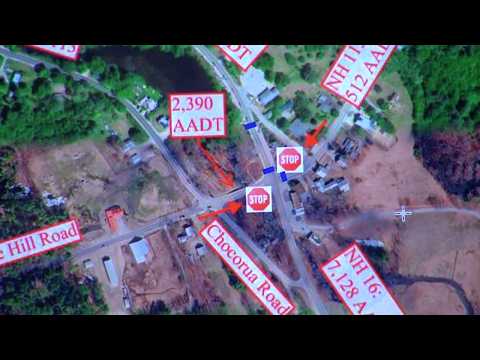
“Regardless of what happens at this particular meeting, we will not do anything if the town's not on board,” said Cory Spedalunes, project manager and safety officer for the New Hampshire Department of Transportation, opening the presentation. Spedalunes described a targeted project that would include NH 16 & 113 in Shakura Village, 113 & Page Hill Road, and 113/113A & Main Street and said all construction and installation would be state-funded.
DOT presented a decade of crash reports and probe speed data showing frequent multi-vehicle crashes at the 16/113 location and 85th-percentile speeds in the mid-40s through a posted 30 mph zone. Spedalunes cited out-of-state case studies — Delaware and North Carolina conversions — that showed roughly 60–70% reductions in crashes and 75–82% reductions in injury crashes after multi-way stop installations.
Spedalunes said the all-way stop is intended as a safety-focused remedy where lesser countermeasures (bigger signs, overhead beacons, vegetation trimming) have failed to change driver behavior. He also showed DOT’s operational modeling: during an average month the traffic delay from converting 16/113 to an all-way stop would be modest, but during peak tourist or foliage periods — the department’s “peak-peak” counts — queues could lengthen and the simulation projected back-ups of up to about a minute to the post office for roughly 15–20 minutes of the day.
The presentation included practical details: DOT said the Manual on Uniform Traffic Control Devices (MUTCD) criteria support multi-way stop placement when crash patterns, sight-distance limitations and traffic volumes align; it also said the state would place advance notice signs and message boards and use conspicuity panels on the new signs to reduce driver confusion during the transition.
Residents and board members raised questions about backups on Route 16 during busy weekends and holidays. “I really feel you're minimizing the amount of backup that will be there,” a longtime resident said, warning that high-volume weekends often produce multi-mile delays. James Steer, a local resident, said he found the proposal “compelling” but worried about congestion at peak times. Another commenter asked whether a signal, rather than an all-way stop, could be timed to protect pedestrians while keeping traffic moving; DOT said signals are a long-term, higher-cost alternative that typically requires regional planning and are therefore unlikely in the near term.
DOT offered monitoring options, including short video or probe-data studies to check stop compliance and hard-stopping metrics after installation. Emma, a DOT safety engineer, said the agency could deploy short-term camera-based monitoring to measure compliance and near-misses if the town requests post-installation review.
Select Board members expressed interest in scheduling a public listening session to gather community feedback. Spedalunes said he plans to include the Tamworth intersections in a statewide project to be advertised in May unless the town requests changes; he estimated construction could occur in early 2027 if the project moves forward.
The Select Board did not take a final vote on the DOT proposal at the meeting. Instead, members agreed to convene a listening session and asked DOT to place both 16/113 and 113/Page Hill in the proposed statewide contract while the town finalizes its position. DOT said the Main Street conversion could be implemented later as an internal DOT project and reiterated there would be no local cost for any of the signs and markings included in the proposed work.
Next steps: the board will host a town listening session (advertised to the public) and is expected to consider a formal recommending vote at a future meeting before DOT proceeds with advertisement of its contract.