Get Full Government Meeting Transcripts, Videos, & Alerts Forever!
Get email alerts on the Land Use topic
No spam. Unsubscribe anytime.
Council rejects Hard Grove rezoning for concrete batch plant after hours of debate and public opposition
Summary
On first read the council voted 4–1 to deny a rezoning request to change 10.44 acres on Hard Grove Lane from IND1 to IND2 for a proposed Hard Rock Materials concrete batch plant; opponents cited truck traffic, dust, water use and compatibility concerns while the applicant offered deed covenants capping trips, truck weight and water use.
Palm Coast City Council on March 17 refused on first reading to rezone roughly 10.44 acres on Hard Grove Lane from IND1 (light industrial) to IND2 (heavy industrial) for a proposed Hard Rock Materials concrete batch plant. The motion failed 4–1 after an extensive hearing that included staff analysis, an applicant presentation and many public comments from neighboring businesses and residents.
Staff (Community Development) presented the rezoning application and recommended approval conditioned on voluntary restrictive deed covenants proffered by the applicant. Planner Michael Hansen described the project site, wetlands and public‑facilities review and said staff found the proposal consistent with the comprehensive plan and the land development code, subject to performance standards and the applicant’s voluntary covenants.
Applicant representatives emphasized economic benefits and controls. Michael Shimento, speaking for the family business, and owner Teresa Petty described the company’s operations and offered a set of deed restrictions intended to limit impacts: a voluntary cap on truck trips ("we wouldn't exceed 200 trips a day," the applicant's team said during the presentation), limits on concrete‑truck sizes to reduce roadway wear, a cap on on‑site water use (capped at 25,000 gallons per day on a 7‑day average), and a limit on diesel fuel stored on site (10,000 gallons max, double‑walled containment).
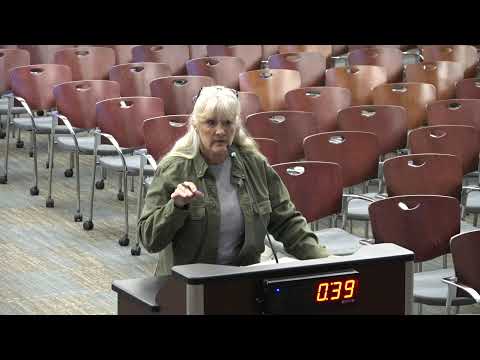
Despite those concessions and an air‑quality consultant’s testimony that operating plants in the applicant’s system pass routine testing, numerous nearby business owners and employees urged denial. Opponents — including auto repair shops, small manufacturers and business‑park tenants — said batch‑plant dust and fine particulates can spread beyond property lines and damage equipment and operations; they also argued heavy trucks would accelerate roadway deterioration on Hard Grove Lane and that the industrial park had been developed for lighter uses. Several speakers warned approving IND2 zoning would create a lasting precedent converting light industrial parcels to heavier uses.
Dylan Chopra, representing a neighboring landowner whose prior rezoning application had been denied, said approving the new request after denying a similar application would create legal and economic reliance issues for developers who adjusted plans after the earlier denial.
The council debated compatibility, buffers and long‑term precedent. Council member comments repeatedly weighed the applicant’s voluntary covenants and economic arguments against the concerns of existing businesses and the potential for a ‘‘snowball’’ effect if IND2 zoning becomes more common in the park. At roll call the vote was: Council member Miller — no; Vice Mayor Ponti — no; Council member Gambaro — no; Council member Sullivan — yes; Mayor Michael Norris — no. The motion to adopt the ordinance on first read failed 4–1.
Staff noted that if an applicant wished to pursue a site plan in the future, additional technical review (traffic, stormwater, air quality, hydrogeology) and permits would be required; the city’s hydrogeologist had recommended locations for any private well on the site to maximize separation from city supply wells. The council requested additional detail and said staff would provide follow‑up information if the applicant decides to resubmit.