Get Full Government Meeting Transcripts, Videos, & Alerts Forever!
Get email alerts on the Retirement Taxes topic
No spam. Unsubscribe anytime.
TRS webinar: 1099‑R mailed by Illinois Comptroller; retirees advised how to use W‑4P and state withholding forms
Summary
TRS presenters told retirees that retirement benefits are federally taxable, 1099‑R forms are typically mailed by the Illinois Comptroller by Jan. 31 (request duplicates from TRS after Feb. 15), and the IRS W‑4P and TRS state withholding forms let members adjust federal and some state deductions.
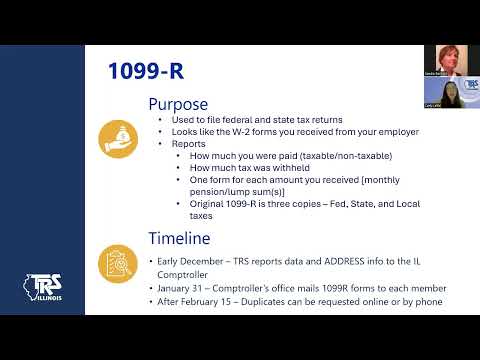
Carly, a presenter for the Teachers' Retirement System Board of Trustees, told retirees in a February webinar that "TRS benefits are federally taxable," explaining most TRS contributions were pre‑tax and therefore taxable when paid as a pension. She said the 1099‑R reports how much TRS paid a member in the year and how much federal tax was withheld.
Carly described the 1099‑R production timetable and mailing: TRS sends address data to the Illinois Comptroller in early December so the Comptroller's office ("Susanna Mendoza's office," she said) can mail 1099‑R forms, which are typically mailed by Jan. 31. Members who do not receive a form by mid‑February may request a duplicate from TRS; Carly said TRS can mail duplicates after Feb. 15 and that members may request them online or by phone.
On form details, Carly walked through commonly questioned boxes: box 1 reports gross distribution for the year, box 2A reports the taxable portion, and box 4 shows federal income tax withheld. She clarified TRS uses box 5 to indicate the non‑taxable portion of an annuity for TRS purposes, and noted box 9B appears only in a member's first year of retirement to show after‑tax employee contributions.
The session also reviewed the IRS W‑4P, which tells TRS how much federal tax to withhold from each monthly pension. Carly warned that the W‑4P changed significantly in 2023 and that TRS created a calculator to estimate withholding under the new form. "The default is the single status," she said, noting TRS uses single as the default because it generally withholds more federal tax. Members can choose a filing status on the W‑4P and, if needed, enter an additional dollar amount in box 4C to reach a target monthly withholding.
Carly reminded members that Illinois does not tax retirement income but that state rules vary. She listed states for which TRS can withhold retirement income tax (Indiana, Kentucky, Iowa, Wisconsin and Michigan) and said Missouri is not covered; members living in other states should consult a local tax professional and, if necessary, file a TRS state withholding request form.
On delivery and submission, Carly recommended using the secure member portal to upload W‑4P and state withholding forms to protect Social Security numbers, but she said forms can also be mailed, faxed, or emailed. She confirmed that a W‑4P received by the 10th of a month will typically take effect with the next pension payment.
During Q&A Carly answered common member scenarios: moving residency (no Illinois withholding if you no longer live in Illinois), the tax treatment of optional service purchased with after‑tax versus pre‑tax funds, and when to contact TRS for unusual cases (for example, reversionary benefits). For issues that require tax‑law interpretation, she repeatedly recommended consulting a tax professional.
The webinar was recorded and slides will be posted on TRS' website at trsil.org. TRS gave contact information for members with follow‑up questions: phone 877‑927‑5877 (Monday–Friday, 7:30 a.m.–4:30 p.m.) and email members@trsil.org. Carly closed by reminding attendees that duplicates of 1099‑R forms can be requested from TRS any time after Feb. 15.