Get Full Government Meeting Transcripts, Videos, & Alerts Forever!
Get email alerts on the Land Use topic
No spam. Unsubscribe anytime.
San Carlos commission grants two‑year extension for 87‑unit Alamita townhouse project over neighbor concerns
Summary
The Planning & Transportation Commission voted 5–0 to extend entitlements for the 808 Alamita De Las Pulgas townhouse project to Nov. 12, 2028. Commissioners and neighbors pressed developer and staff on geotechnical safety, fire water, bonds and the developer’s financing; staff said EIR mitigations remain enforceable and the extension is timely under SB 2729.
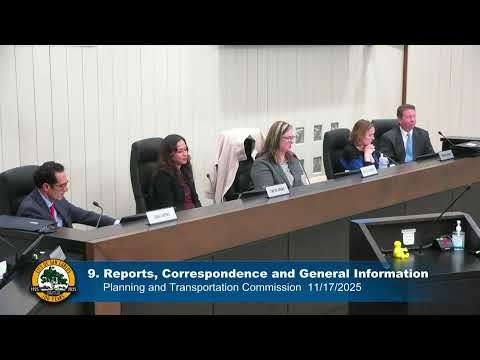
The San Carlos Planning & Transportation Commission voted 5–0 on Nov. 17, 2025 to grant a two‑year extension of entitlements for a previously approved 87‑unit townhouse development at 808 Alamita De Las Pulgas, extending the approvals to Nov. 12, 2028.
Staff planner Lisa Costa Sanders summarized the project and the request. The commission approved the project on May 1, 2023 for a two‑year vesting period that would have expired in May 2025; state legislation (SB 2729) automatically extended the entitlement period by 18 months to Nov. 12, 2026. The applicant requested an additional two‑year extension to allow time for civil and public‑improvement plan submittals and to complete financing. The site is roughly 11 acres with an average slope of about 28.5 percent; the approved plan calls for 87 townhomes (two‑, three‑ and four‑bedroom types), two‑car garages, 10 deed‑restricted low‑income units, 17 attached clusters, about 3.6 acres to remain in natural state, and a public street that would connect through to Coronado Avenue.
Lisa Costa Sanders told the commission that the project has an approved EIR, adopted mitigation and a mitigation monitoring and reporting program; those mitigation measures remain in force for the life of the entitlements. She said the project must submit design‑level geotechnical reports and comply with building and fire codes in effect at the time of building permit submittal (the city adopted the 2025 building code, effective Jan. 1, 2026). Staff noted that the adjacent Vista del Grande applicant has signaled interest in citing AB130 for a new submittal, and that if AB130 applies to a later resubmittal it could eliminate the need for CEQA review for that future application — a change staff flagged as material for commissioners to consider.
The applicant’s attorney, Chris Powell, and developer Amit Holler said civil engineers are preparing drainage, grading and stormwater plans (targeted for mid/late December) and public‑improvement plans (targeted for January 2026). Powell said the contractor and civil team are lined up and that the developer is spending on design now; he argued an extension avoids wasting millions in entitlement and engineering work if temporary financing or market timing causes short delays. Powell said, "This project has been fully evaluated under CEQA," and emphasized that detailed engineering and plan checks would address slope and fire concerns at the building permit stage.
Neighbors and commissioners asked detailed questions about safety if the site were graded and construction stalled. Commissioners and staff explained that grading and public‑improvement bonds are required so the city can finish critical public work and stabilize the site if a developer stopped work, that detailed geotechnical reports are required before grading permits are issued, and that the fire marshal can impose additional conditions where needed. Commissioner Anand summarized a frequent sentiment in the public record when he said, "Housing delayed is housing denied," and urged the developer to provide clear, timely public milestones to rebuild trust with neighbors.
A public commenter, Debbie Baldaki, said she submitted most of the written comment letters and raised concerns about the developer’s prior business track record, the steepness of the site, and the risk of runoff into the adjacent creek during heavy storms. Baldaki said she wanted to preserve all mitigation measures in the current EIR. The developer replied that lenders perform extensive diligence and that phased construction and lender protections help reduce the risk of an abandoned, half‑built site.
After deliberation, the commission made findings that the extension request was timely and consistent with applicable municipal code and state law, that it did not reopen or modify previously approved conditions or environmental findings, and that enforcement of mitigation measures would continue at the permit stage. The motion to adopt the resolution granting a two‑year extension passed by roll call: Chair Clemens — yes; Vice Chair Bundy — yes; Commissioner Anand — yes; Commissioner Cany — yes; Commissioner Tabias — yes.
The chair read the appeal period: because of the Thanksgiving holiday the deadline to file an appeal is 5:00 p.m. on Monday, Dec. 1, 2025. Staff and several commissioners asked the developer to provide ongoing public milestones (schedule updates and contact information) so neighbors could track plan‑check and construction progress.