Get Full Government Meeting Transcripts, Videos, & Alerts Forever!
Get email alerts on the Ohv Pilot Program topic
No spam. Unsubscribe anytime.
Needles unveils pilot to let off-highway vehicles use five city routes, with strict rules and a two-year review
Summary
City of Needles officials and agency partners on Feb. 9, 2026, outlined a pilot program allowing off-highway vehicles on five designated city routes (9.2 miles), detailing route maps, signage, sticker/registration rules, day-only operation and enforcement roles; a state report due Jan. 1, 2033 will guide any extension to 2034.
City of Needles officials and state and federal partners on Feb. 9 outlined a pilot program that will let properly registered off-highway vehicles (OHVs) use five designated routes inside city limits.
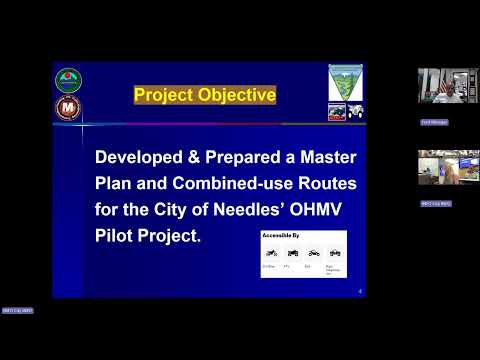
Fred Minagar, principal of Minagar & Associates, said the plan designates five city routes with two staging areas and a 9.2-mile combined loop that connects to Bureau of Land Management trailheads. "We analyzed all those routes within 9.2 miles to make sure ... from a geometry perspective, from civil engineering, from public safety," Minagar said, describing route segments, staging locations at River Road/Park Drive and Clary Drive/Lily Hill, and federal-standard brown signage to mark start and end points.
The legal framework for the pilot is grounded in state action the presenters said began with Assembly Bill 2152; speakers also referenced a related legislative extension (identified in the meeting as AB 1756) that would allow a longer pilot if the state approves future renewal. Minagar said the city must prepare a final pilot report for the state by Jan. 1, 2033; that report will document safety, environmental and enforcement outcomes and could support an extension of the pilot to Jan. 1, 2034.
The program will cap OHV speeds at 35 mph on designated routes unless local posted limits are lower. "Users must comply and conform with driver's license having proper State of California or Arizona or Nevada driver's license. Helmet is a must and they must have all the required insurance coverages," Minagar said. Officials said patrons may turn off the designated routes only at lodging or service locations; otherwise users must stay on route.
Registration and sticker rules were highlighted: green stickers for residents (year-round), yellow for non-residents and red stickers the speaker said are being phased out. Minagar warned that existing green stickers expire in June 2026 and users should be prepared for new issuance timelines; stickers are issued by the DMV or authorized vendors and are valid for two years.
Representatives from the BLM, California Highway Patrol and the San Bernardino County Sheriff's Department described how their agencies will support the program. Ron Knuckles, Needles Field Manager for the BLM, warned that much of the BLM-managed land in the field office includes wilderness or areas of critical environmental concern and urged riders to "stay on designated trails" to avoid creating new routes through sensitive areas. A BLM ranger explained Carsonite intersection markers that help dispatch locate riders in the field.
Lieutenant Robert Edelman of the California Highway Patrol and Captain Jake Dault of the San Bernardino County Sheriff's Department said the program's enforcement focus is safety and compliance: daylight-only use of city routes, helmet and registration checks, and citations for violations that could threaten the pilot's future. "Stay on the route, drive slow, be aware of everything that's around you and get to where you need to go," Captain Dault said.
City staff said signage fabrication and installation are next steps, with a planned signage install by June followed by a soft opening and a Nov. 7 ribbon-cutting during the city's Centennial event. Officials also said the city will post maps, FAQs and outreach materials on the city website and will run education and officer training before full deployment.
Why it matters: Needles will be the first city in the state to implement a combined-use OHV streets program of this type, presenters said, and leaders framed the plan as a potential economic development tool for winter tourism while stressing that the pilot depends on public compliance and careful enforcement.
What happens next: Staff will publish route maps and FAQs on the city website, install signs, conduct officer training and collect safety/environmental data for the Jan. 1, 2033 report to the state.