Get Full Government Meeting Transcripts, Videos, & Alerts Forever!
Get email alerts on the Historic Preservation And Wildfire topic
No spam. Unsubscribe anytime.
Nevada City considers changing preservation rules to protect historic downtown from wildfire
Summary
At a joint meeting, city and planning commissioners heard Headwaters Economics warn that embers cause most home loss and urged updating design guidelines and codes so historic buildings can be ‘hardened’ without losing character; staff will bring a proposal and a small ad hoc committee was agreed as the next step.
Nevada City officials and planners opened a public conversation about changing historic‑preservation rules to reduce wildfire risk, hearing on Tuesday from Headwaters Economics that embers—not visible flame fronts—are the dominant cause of home loss in wildfires.
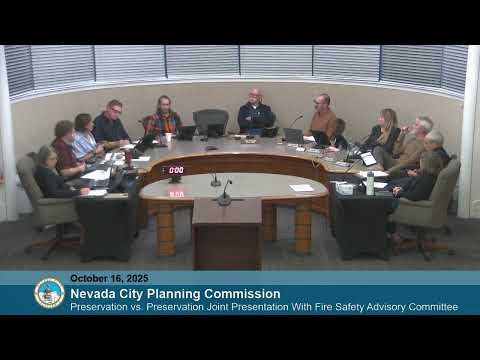
Council Member Peterson told the joint meeting of the Fire Safety Advisory Committee and the Planning Commission that protecting the city’s historic fabric is central to Nevada City’s identity and economy, noting that “Nevada City’s future is in the preservation of its past.” He also warned that some local ordinances may prevent use of materials that could help harden buildings against embers and urged a careful, community‑engaged review rather than wholesale change.
Ryan Handy, co‑program manager for Headwaters Economics’ Community Planning Assistance for Wildfire program, explained three primary ignition pathways—flame contact, radiant heat and embers—and said embers are “responsible for 90% of all home loss” in wildfire events. Handy and his colleagues recommended a mix of near‑term, low‑cost measures (cleaning gutters, sealing vents and maintaining a noncombustible 0–5 foot zone around buildings) alongside code and design‑guideline changes to allow targeted hardening of historic buildings without sacrificing their visual character.
Why it matters: Nevada City’s downtown and historic district are major tourist draws and a substantial part of the general fund revenue. Commissioners and residents voiced concern that losing the downtown to wildfire would be both a cultural and economic catastrophe, and several speakers said the city should prioritize affordable, evidence‑based interventions for owners who cannot fund major retrofits.
Panelists said federal preservation standards (the Secretary of the Interior’s standards) were not written with wildfire hazards in mind and that the National Park Service is planning guidance on adapting preservation practice for climate hazards; SEPAW expects a policy brief on wildfire adaptation sometime in 2026 but advised communities not to wait to act.
Commissioners debated where to begin—code changes, design‑guideline updates or an impact assessment. Planning Commissioner Alex Kolto urged the group first to decide what values the city wants preserved (original materials versus overall visual/aesthetic character), saying that decision should guide which adaptations are acceptable. SEPAW said it would produce a matrix linking preservation approaches (preserve, rehabilitate, reconstruct) to potential fire‑risk interventions.
Public commenters urged practical steps. Property owner Bill Lichfield recommended that the city help owners understand rebuilding costs and insurance adequacy; resident and environmental planner Lori Oberholtzer urged a carefully curated list of acceptable replacement materials so updated rules still reflect Nevada City’s aesthetic.
Next steps: Commissioners and staff agreed to pursue a small joint ad hoc committee (three to five people) with staff and SEPAW support to identify high‑impact changes and produce recommendations for the City Council. Staff committed to place a related item on a future council agenda for formal consideration; no formal vote was taken at the meeting.
The meeting highlighted tradeoffs—historic authenticity versus resilience—and staff emphasized starting with low‑cost, high‑impact steps while developing code and guideline options for longer‑term changes.