Get Full Government Meeting Transcripts, Videos, & Alerts Forever!
Get email alerts on the Enrollment And Facilities topic
No spam. Unsubscribe anytime.
PASA demographers tell BOERNE ISD to plan for steady enrollment growth; elementary capacity could be strained by 2035
Summary
Demographers presented at BOERNE ISD’s March 2 budget workshop, projecting continued housing‑led student growth and a districtwide student‑per‑home ratio decline; under a primary scenario the district could reach ~13,372 students in five years and would need capacity planning to avoid elementary overcrowding by the mid‑2030s.
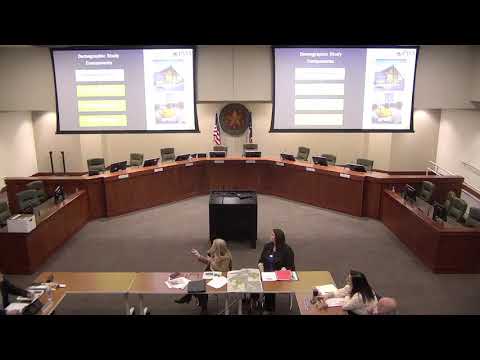
Consultants from Population & Survey Analysts (PASA) told the BOERNE ISD Board on March 2 that continued residential development will keep student enrollment rising, but fewer students are showing up per new home — a combination that requires detailed, subdivision‑level planning for new facilities.
PASA lead presenter Chris (PASA) summarized the study process and key findings, saying, “the ratio of students per household for you guys right now is 0.45,” and that the firm uses parcel‑level appraiser data, geocoded student addresses and per‑subdivision yields to produce projections. The consultants told trustees a full study takes about four months and the district receives a full study every two years with mini‑updates in between.
The presentation said BOERNE ISD has participated in regional growth tied to a ring of suburban expansion outside the San Antonio metro area and that the district gained roughly 1,500 students over the past five years (about 3,200 over 10 years). PASA projected under a primary scenario roughly 13,372 students in about five years and about 16,500 students in 10 years, but emphasized shorter‑term forecasts (two to three years) are more reliable for immediate budgeting.
Caroline Crouch (PASA) reviewed the housing picture, estimating BOERNE ISD will add about 18,000 housing occupancies over the next decade: about 13,000 single‑family units (71.5% of growth), ~4,400 multifamily units (24%) and the remainder age‑restricted or other types. Major single‑family drivers named in the presentation included the Espironza master plan (projected buildout ~2,900 homes), Corley Farms (>800 homes), Portierra Ranch (>700 homes), Ranches at Creekide (~600 homes) and Regent Park (>400 homes).
PASA flagged that housing alone does not determine enrollment: alternative educational options (charter schools, private schools, virtual programs and homeschooling) materially affect yields. Chris (PASA) estimated the district’s current capture rate — the proportion of resident school‑age children attending district schools — at about 88%, with roughly 9.8% attending private schools. They also noted that developing subdivisions have lower yields (about 0.38 students per home) than existing neighborhoods (~0.47).
Trustees asked technical questions about school capacity baselines and temporary buildings. District staff explained their capacity calculations are classroom‑based (e.g., K–4 classrooms multiplied by grade weights) and said baseline capacity figures exclude temporary classrooms. The board discussed attendance‑zone adjustments and program placement (for example, Spanish immersion) as tools to even out utilization across campuses.
PASA also reviewed uncertainty drivers the district should monitor closely: charter school approvals, private‑school expansions, closures that could return students to the district (PASA estimated the closure of one local facility might return ~26 students), and the state Education Savings Account (ESA) rollout. Trustees and consultants cited a recent statewide ESA applicant figure reported at about 130,000 and said award timing (lottery, notices in May/June) could affect private‑school reenrollment decisions and district capture rates.
On facilities, PASA used a practical planning threshold of roughly 120% school utilization as a trigger for seeking new permanent capacity. Under their primary scenario, several southern and western attendance zones could approach or exceed that threshold by the end of the 10‑year horizon; under a reduced‑enrollment scenario (which assumes stronger ESA/charter impacts or slower housing absorption) immediate pressure is eased.
District administration said budget assumptions for 2026–27 remain under development but that the board will continue using PASA’s updated projections as a basis for staffing and long‑range facility planning. The board scheduled follow‑ups in March and April and adjourned after a motion by Rich Senna, seconded by Sarah Falenberry.
Next steps noted: staff will refine attendance‑zone options, monitor ESA/charter developments over the summer enrollment cycle, and incorporate PASA’s planning‑unit projections into the April budget workshop.