Get Full Government Meeting Transcripts, Videos, & Alerts Forever!
Get email alerts on the Local Budget topic
No spam. Unsubscribe anytime.
Waverly resident urges council to slow or reschedule spending as property taxes rise
Summary
At a special City of Waverly meeting, resident Brock Sands urged council members to phase or delay projects to ease rising property tax burdens; a city staff member explained how valuation increases, state rollback rules and use of local option sales tax (LOST) affect the city portion of taxes and the golf renovation funding.
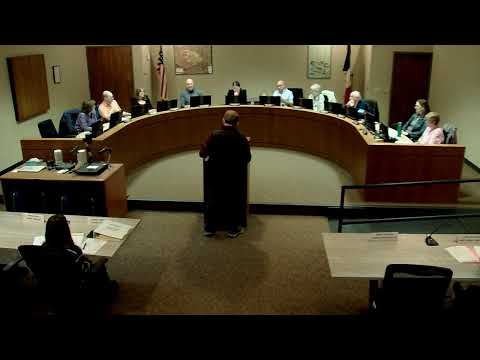
Brock Sands, a longtime Waverly resident, told the City Council that rising property taxes are producing “a meaningful portion of take‑home pay” lost for many households and urged the council to prioritize and pace spending to ease pressure on fixed‑income residents.
Sands said the fiscal year 2026 property tax levy report shows a combined city, county and school rate of about $37.69 per $1,000 of taxable value and used example calculations to describe household impacts: roughly $2,600 a year for a $150,000 home and about $5,000 for a $300,000 home. “For many residents, this represents a meaningful portion of their take‑home pay,” he said, adding that older residents and those on fixed incomes are particularly vulnerable.
City staff responded with context about valuation and funding sources. A city staff member said the $37 figure Sands cited combines city, county and school levies and that the city’s proposed portion for the next year is 17.5 per $1,000 of taxable value. The staff member also explained that recent increases in assessed values—one example given was a home rising from $272,900 to $391,190—combined with Iowa’s rollback adjustments can limit the city’s net revenue growth despite city valuation gains.
Sands also asked whether local option sales tax (LOST) funds could be used to provide property tax relief or to support affordable housing, and whether items previously rejected by voters are being reconsidered for LOST funding. The staff member described the current golf clubhouse proposal as a renovation priced at about $2.6 million (not the earlier $5.5 million rebuild) that would use a large share of LOST rather than city property tax revenue. According to the staff presentation, roughly two‑thirds of the renovation cost was planned to come from LOST, with about $965,000 over 10 years associated with the city share—an equivalence the staff characterized as roughly $9 per $100,000 of taxable value in the example provided.
The staff member noted that many capital items—such as police vehicles, ambulances and other equipment—are commonly funded from LOST and that rising equipment costs have increased those budget pressures. On the golf renovation specifically, staff said that shifting the project entirely to LOST would remove a direct city property tax charge for that item and that, using the staff’s example, the incremental city property‑tax impact on an individual homeowner would be modest.
Sands closed by urging the council to consider phasing projects and delaying lower‑priority items to reduce the cumulative burden on residents and encouraged more public participation at council meetings so citizens can get answers about funding and timing. The recorded segments include no final vote on the proposed budget; the meeting did include a routine voice vote to approve the meeting agenda earlier in the session.