Get Full Government Meeting Transcripts, Videos, & Alerts Forever!
Get email alerts on the Housing Supply topic
No spam. Unsubscribe anytime.
Home builders urge St. Tammany Parish to act on housing study that finds 11,000–17,000-unit shortfall
Summary
Developers and the Home Builders Association told the reopened Agenda Review Committee that a parish-commissioned housing needs assessment shows nearly 43% of the workforce commutes in and projects a need for 11,000–17,000 new units by 2030; council members said the study is a planning tool and cautioned about constituent opposition and infrastructure limits.
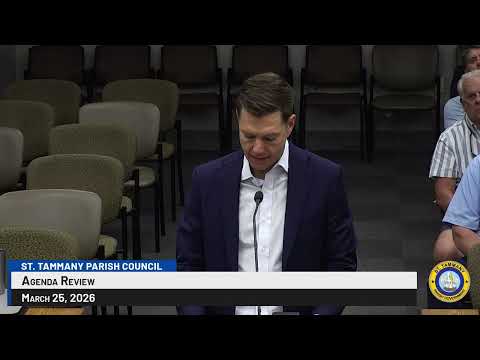
Jeff Vallee, a local developer and founder of H-1 Associates, told the St. Tammany Parish council’s reopened Agenda Review Committee that the parish-commissioned housing needs assessment shows a substantial shortfall in housing and urged the council to clear uncertainty that slows projects.
"Nearly 43% of the workforce is commuting into the parish... the study states the parish will need 11,000 to 17,000 new units by 2030," Vallee said, summarizing figures he said were produced by the consultant the parish hired. He told the council that the New Directions 2040 plan and the Unified Development Code (UDC) identify suitable locations and that the next step is to approve well‑planned rezonings and cut avoidable delays.
The study and its figures were the focal point of public comments from several members of the building community. Cecil Hudson, vice chair of the Home Builders Association, thanked the council for producing the "400‑page" assessment and asked officials not to exclude builders from follow‑up work: "We are the provider for both of those," Hudson said, referring to rooftops that support commercial and economic growth.
Donald Jenkins of Jenkins Homes emphasized workforce and economic effects, saying local businesses and public services suffer when employees commute in from other parishes. "This is a bigger problem than just the 200 or 300 people at a town hall," Jenkins said, arguing that parish‑wide needs may differ from the views expressed at local meetings.
Builders and industry speakers pressed two recurring themes: that capacity and utility reservation fees and the cost of extending mains and services are major drivers of development costs, and that moratoriums on multifamily development limit the parish’s ability to add apartments and rental housing. One official at the meeting noted capacity reservation fees and utility charges rose in 2024 and that developers often bear the cost of extending service mains.
Council members responded with a mix of caution and support. Councilman Kugel said he had not received constituent requests to "build twice as fast" and objected to the reopening procedure that allowed additional public comments without forms, calling procedural fairness a significant concern. Other council members, including Mr. Strickland, described growth as inevitable and said new housing is needed to retain workers such as nurses, teachers and first responders.
Members also emphasized limits the council must weigh when considering action. Councilman Casaubon said any new housing should come where land is suitable and infrastructure exists and highlighted past mistakes that led to flood‑prone development. Miss Seiden noted the parish’s inbound workforce share is much higher than the national average and suggested revitalizing older neighborhoods as one approach to increasing housing supply.
The committee first debated and then voted to reopen the Agenda Review Committee for public comment; the transcript records the motion to reopen as passing with nine yes, two no and three absent. After public comment concluded, the committee adjourned.
Next steps discussed at the meeting included further review of the housing needs assessment by council committees, potential targeted rezonings aligned with New Directions 2040 and continued consultations with developers to identify regulatory changes and infrastructure strategies that could lower development costs.
The record shows the study acted as a planning tool that prompted both calls for action from the building community and council caution about process, constituent views and infrastructure constraints.