Get Full Government Meeting Transcripts, Videos, & Alerts Forever!
Get email alerts on the Ct Paid Leave Withdrawal topic
No spam. Unsubscribe anytime.
How sole proprietors can withdraw from Connecticut Paid Leave
Summary
Connecticut Paid Leave explains rules for sole proprietors to end program participation: a mandatory three-year minimum enrollment, a 30-day written notice requirement, acceptable proof for out-of-state moves or business closure, possible penalties equal to a quarter's contributions, and a four-quarter readmittance waiting period.
Amber Forrest, executive assistant for Connecticut Paid Leave, outlined how sole proprietors and self-employed individuals can end participation in the state program and what documentation and timing are required.
Forrest said that when sole proprietors enroll they make "a commitment to a mandatory minimum 3 year enrollment period," and that the enrollment "auto renews after that 3 year period" if prior notification is not provided. She advised participants they cannot withdraw merely because they no longer want to contribute and must be current on contribution obligations before withdrawal is allowed.
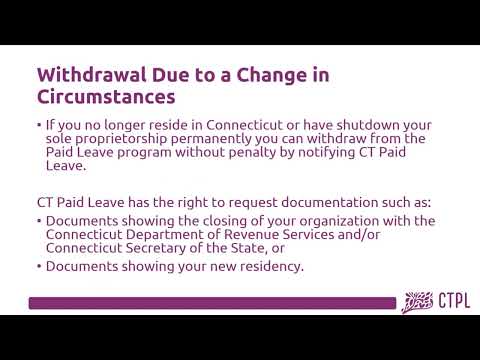
Participants who experience a change in circumstances may be eligible to withdraw without penalty, Forrest said, giving two examples: moving outside Connecticut or permanently ending the sole proprietorship. Acceptable proof includes filings showing the closing of the business with the Connecticut Department of Revenue Services or the Connecticut Secretary of State, or documentation of new residency such as a new driver's license, vehicle registration, an official change-of-address form, a utility bill, a letter from a public authority, a new insurance policy, or a rental or mortgage statement.
Forrest instructed that anyone seeking to end participation must provide 30 days' written notice and may submit the initial inquiry through the program website at ctpaidleave.org via the Contact Us page (select the subject "contribution question"). She noted that documentation cannot be attached to the initial contact-us inquiry; the contact team will respond with instructions for how to provide supporting documents.
On penalties, Forrest warned that "if the 30 day notice is not received, Connecticut paid leave may apply a penalty equal to 100% of the last full quarter's contribution amount prior to the effective date of the withdrawal." She repeated that if withdrawal occurs prior to the end of a coverage period the program "may apply a penalty equal to 100% of the contribution amount owed for the last full calendar quarter prior to the effective date of the withdrawal," and that additional penalties may be assessed when required notice is not provided. Penalties, she said, cannot be paid with funds deducted from employees' wages; however, Connecticut Paid Leave "has the right to waive penalties at its own discretion" if doing so would be consistent with equity and good conscience.
Regarding re-enrollment, Forrest said an individual who withdraws as a sole proprietor will not be eligible to reenroll in that status until four full calendar quarters after the later of the effective withdrawal date or the date the withdrawal request was provided to Connecticut Paid Leave. She clarified that forming a new business entity does not circumvent the waiting period, but noted that a person who becomes an eligible employee of a covered employer may still receive benefits under the program.
For more information and to begin the withdrawal process, Forrest directed viewers to ctpaidleave.org.