Get Full Government Meeting Transcripts, Videos, & Alerts Forever!
Get email alerts on the Apprenticeship Funding topic
No spam. Unsubscribe anytime.
Stakeholders divided over four ETP apprenticeship funding models; panel to recommend April next steps
Summary
At a Friday listening session the Employment Training Panel heard staff present survey results and four draft funding models; unions generally favored a per‑apprentice base rate while workforce and equity groups pushed hybrid models that reserve pools for emerging programs and regional demand. Stakeholders also pressed for greater transparency and clearer data verification.
The Employment Training Panel’s apprenticeship subcommittee gathered Friday afternoon for a stakeholder listening session on four proposed funding allocation models and to collect written and oral input before staff prepares a recommendation to present to the full panel in April.
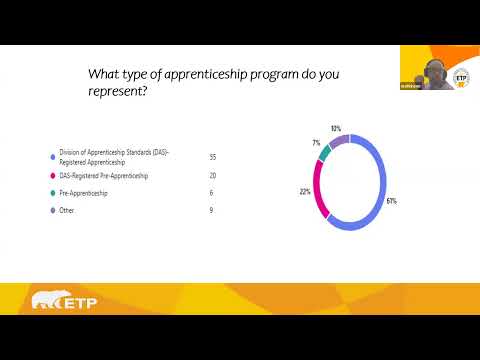
Willie Atkinson, Assessment Programs Manager for ETP, told the room the agency received 57 survey responses from roughly 250 invited stakeholders and used open‑ended write‑ins to develop four draft models: symmetrical scaling (uniform proportional reductions), a flat per‑apprentice base rate, a hybrid split between established and emerging programs, and a hybrid combining proportional scaling by trade with a pool tied to state and regional workforce demand.
The meeting’s public comments revealed clear differences among stakeholders. Trade apprenticeship representatives and joint apprenticeship and training committees (JATCs) generally favored the per‑apprentice base rate (option 2), arguing it is administrable and predictable for programs that employ apprentices during training. Tony Hernandez of NorCal Carpenters recommended “per‑apprentice base rate … based on the number of programs under an umbrella, and then still keep that cap number in there” to balance large and small programs. Several union training directors asked that ETP continue to allow funding for journey‑level and upskilling classes in some circumstances so programs can maintain equipment and credentials.
Workforce and equity organizations urged reserving funds for new and underrepresented pathways. Cami Peer of NextGen California and Apprenticeships for America said the panel should “support the number 4, hybrid state and regional workforce demand model,” arguing it preserves accountability while directing resources to emerging sectors such as healthcare and clean energy. The International Rescue Committee recommended option 3 (a hybrid split between established and new programs) to fund bridge and pre‑apprenticeship services for new Americans who face language and credentialing barriers.
Many commenters emphasized transparency and data accuracy. Kelly Greer (Strategy Workplace Communication) told the panel “the process needs to be transparent, and the formula to determine funding distributed needs to… be articulated and published for all stakeholders to see,” and several speakers raised concerns about relying solely on DAS registration records because of known backdating and entry delays.
Panel members and staff questioned practical implementation details: whether an umbrella sponsor should receive a single contract or multiple contracts for different occupations, how caps should be applied, how to validate apprentice headcounts (program records, DAS registrations, or cross‑checks with payroll/EDD), and whether to include pre‑apprentice or journey‑level counts in funding formulas. Chair Brett Court said staff will take the listening session feedback and draft a recommendation; staff and the subcommittee aim to present to the full panel in April, with Willie Atkinson tasked to produce detailed options analysis.
The session closed with a reminder that, regardless of the model chosen, stakeholders expect clear formulas, published methodology, and mechanisms to protect the integrity of registered apprenticeship — including wage and retention standards — while addressing equity and regional workforce needs. The panel adjourned at 4:04 p.m.