Get Full Government Meeting Transcripts, Videos, & Alerts Forever!
Get email alerts on the Solid Waste Fees topic
No spam. Unsubscribe anytime.
Santa Barbara committee votes to phase in higher fees for in‑place curbside collection
Summary
The Sustainability Council Committee voted unanimously May 7 to phase in higher fees for optional in‑place curbside solid‑waste service after staff reported a roughly $1.2 million annual shortfall; the committee modeled a three‑year phase‑in (Option B) to reduce immediate impacts on tenants and vulnerable households.
A three‑member City of Santa Barbara Sustainability Council Committee voted unanimously May 7 to adopt a phased increase to the optional in‑place curbside solid‑waste fee after staff said the program faces an approximately $1,200,000 annual shortfall.
Environmental specialist Dustin Murback told the committee the city has about 15,000 standard curbside accounts, roughly 665 waiver accounts for customers who qualify because of age or disability, and about 1,400 accounts currently paying for in‑place service. Under the current contract, Murback said, the city pays MarBorg Industries $25 per container per month while customers are charged a flat $44.89 per account. "We are looking at an annual shortfall of $1,200,000," Murback said.
The committee considered two staff options. Option A would immediately raise customer charges to recover full cost. Option B phases in cost recovery over three fiscal years and draws on reserves in the near term (staff modeled a $600,000 draw in FY27 and $300,000 in FY28) to smooth rate impacts before recovering the reserved amounts from rates later. Staff said Option B was modeled in the proposed budget.
Why it mattered: staff and members stressed the equity trade‑offs. Several members and a ratepayer who spoke during public comment said optional users should pay the full cost now to avoid shifting costs to nonusers. A public commenter who identified himself as Michael Chukas urged immediate cost recovery, saying "if people are choosing a premium service that we should do option A." Other committee members pushed back, citing tenants who lack control over utility pass‑throughs and the potential for hardship if charges jumped at once.
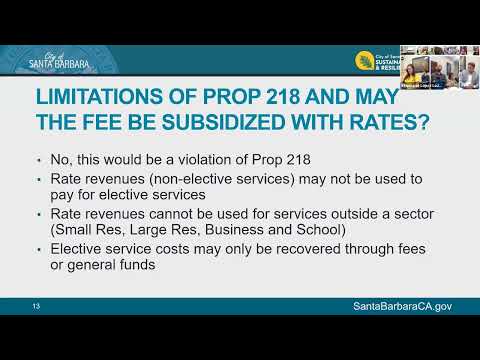
Legal limits shaped the choices. Staff said waiver qualifications and the scope of any subsidizing action are defined by the city's franchise agreement and city legal guidance. City counsel and staff referenced Proposition 218 and state constitutional constraints, saying rate revenues cannot be used to subsidize elective services and that customers must be charged for the service they receive.
Operational context and mitigation: Murback described outreach and operational steps to limit customer cost increases — targeted route audits, improved waiver application visibility, and customer assistance from MarBorg Industries and the Clean Community Division to help customers "right‑size" accounts. Staff also highlighted that most small residential accounts have three carts, creating efficiency and informing per‑cart fee designs. Representatives said a small number of outlier accounts (staff identified eight very large cart accounts) will receive individualized outreach.
Vote and next steps: Committee member (name on the record: Megan Harmon) and Committee member Eric Freeman joined Chair Kristen Sneddon in voting yes to adopt Option B. The clerk recorded the roll call and the motion passed. Staff said they would return related materials to council on June 2 and that further operational questions (including possible appearances by MarBorg representatives and any contract discussion) could be added to a future work session.
What remains unresolved: committee members asked staff to pursue route‑audit results and, if audits show widespread infeasibility of curbside transition unrelated to waiver conditions, to consider whether contract renegotiation is warranted. The committee also left open additional discussion about the franchise agreement terms and the distributional effects on tenants.
Authorities referenced in the meeting include Proposition 218 and state constitution Article 13 (as cited by staff during legal explanation) and the city's franchise agreement with MarBorg Industries. The committee's action was procedural (direction to implement Option B into the budget process) and carries follow‑up reporting and potential future deliberations.