Get Full Government Meeting Transcripts, Videos, & Alerts Forever!
Get email alerts on the Municipal Finance topic
No spam. Unsubscribe anytime.
Chandler says Imperial Beach investment portfolio outperformed benchmark; council raises policy questions on exclusions
Summary
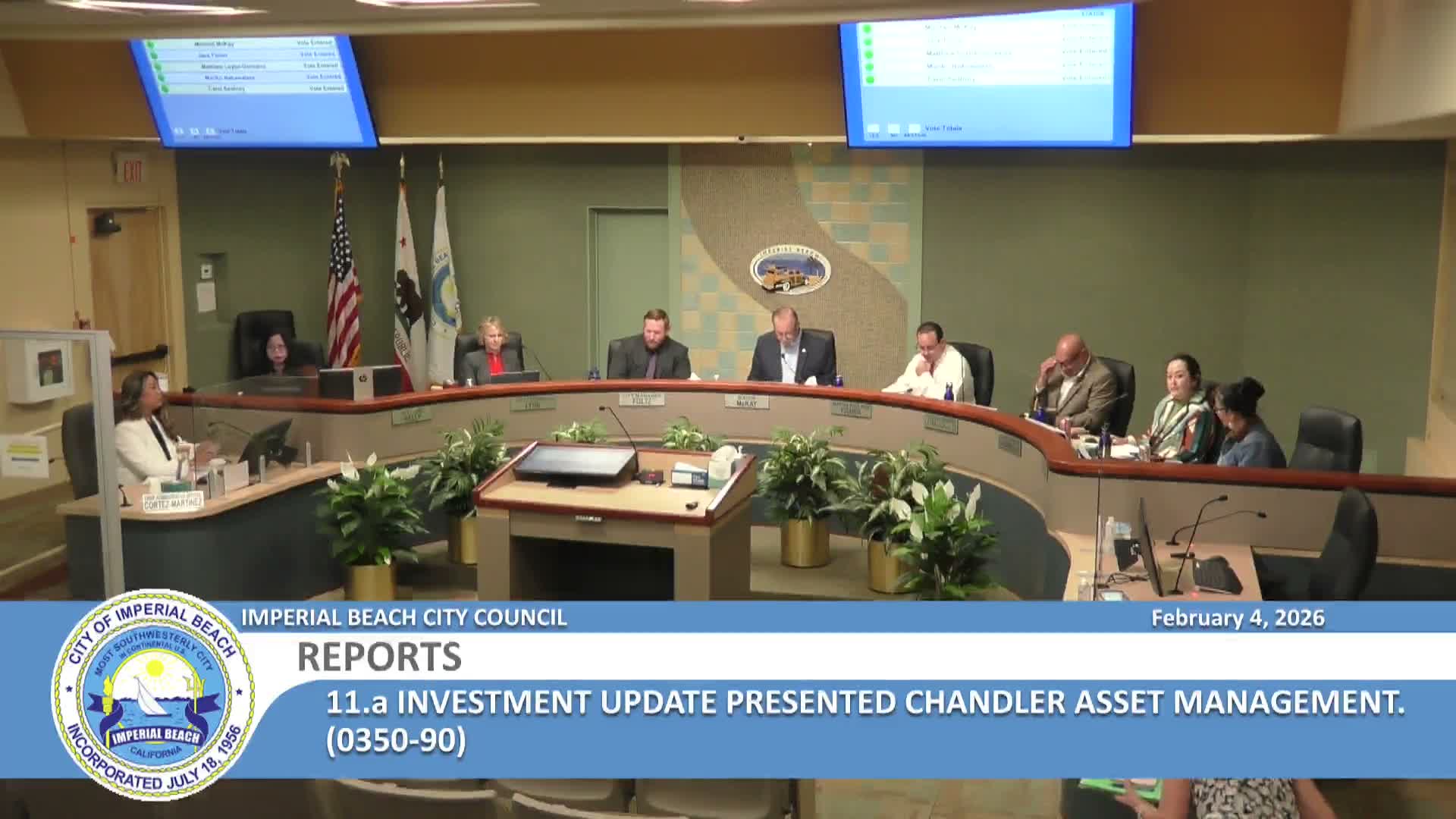
Chandler Asset Management told the Imperial Beach City Council on Feb. 4 that the city’s portfolio was in compliance and produced stronger-than-benchmark returns; councilmembers asked whether the city’s investment policy should be revisited to reconsider exclusions such as fossil-fuel holdings and how to treat AI-related corporate debt.
Jenny Linkiewicz of Chandler Asset Management presented Imperial Beach’s Dec. 31 investment report to the City Council on Feb. 4, saying the city’s portfolio was in compliance and delivered strong results.
Linkiewicz told the council the portfolio was structured for "safety, liquidity, and then yield," and showed a weighted average purchase yield of about 4.34% compared with a prevailing market yield of roughly 3.69%. She said the city’s portfolio was about $25,270,000 and that Chandler was "targeting a slightly longer duration, to lock in those higher yields." The firm reported roughly $272,000 in pickup over the quarter and that about 63% of holdings were U.S. Treasuries and agencies, with roughly 24% in high‑quality corporate securities and ~8–9% in AAA asset‑backed securities.
Linkiewicz noted macro conditions that affected returns, including recent Federal Reserve rate cuts and longer‑term yield movements. She also mentioned that ratings agency changes — "back in May, Moody's downgraded the U.S. government" — were reflected in the materials provided to council.
Council members focused questions on the city’s investment policy and limits. Mayor Pro Tem Jack Fisher asked whether the policy’s exclusions (which he described as longstanding) might merit review; Linkiewicz said the policy currently excludes many energy company bonds at the city’s request, and that large energy issuers such as Exxon or Chevron would not typically be eligible under current credit‑rating and policy constraints. "Companies like Exxon and Chevron would be examples of companies that we would not buy in the portfolio because of the investment policy restrictions that you currently have," she said.
Councilmembers also pressed on labor‑market indicators and what Chandler checks in its economic outlook. Linkiewicz described underemployment as people working part time who would prefer full time and said Chandler was watching labor‑market shifts and their possible effects on yields. When asked about debt issued by technology companies to fund artificial intelligence projects, Linkiewicz said some large technology firms have been issuing investment‑grade debt and that Chandler would consider such securities when they met the city’s high credit‑quality requirements.
The council received the report and thanked Chandler for the presentation. Mayor Pro Tem Fisher asked staff to bring back a review of the city’s investment policy for council consideration at a future meeting.