Get Full Government Meeting Transcripts, Videos, & Alerts Forever!
Get email alerts on the Tiff Reports topic
No spam. Unsubscribe anytime.
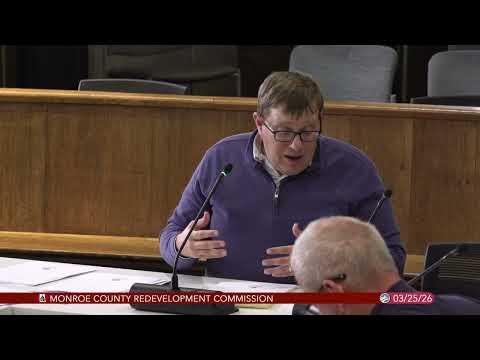
Commissioners send corrected TIF reports to county council after review, approve filing 4–0
Summary
After reviewing four annual tax-increment finance (TIF) district reports, commissioners asked staff to correct maps, clarify tax-rate tables, add district debt-service estimates and annotate speculative revenue assumptions; they voted 4–0 to have consultant FSG submit revised reports to the county council and the Indiana Gateway.
The commission reviewed annual reports for four tax-increment finance (TIF) districts, identified format and data inconsistencies and voted to have consultant FSG prepare corrected versions for submission to the county council and the Indiana Gateway.
At a meeting focused on the Curry Profile, Fullerton Pike, Bloomington Township and West Side TIF reports, staff leading the review said some reports lacked consistent fields—such as allocation-area definitions, clear beginning and sunset dates, and maps with matching parcel numbers—and recommended standardizing cover pages so readers could quickly see each district’s start and end dates.
In the Curry Profile discussion, staff said the district stemmed from a 2018 sale of the former GE site; a later purchaser (referred to in the reports as Simra) has taken on manufacturing at the property. The presenter reported an accelerated-paydown strategy to remove bond obligations and said a small remaining bond balance (reported in the materials at roughly $10,600; one figure appears later in the draft as $10,660) would be paid this year and then allowed to re-accumulate for nearby projects. "We gave more, but we got more," the presenter said of an abatement package offered to the purchaser, arguing that the incentives brought investment and jobs.
Charlie, participating remotely, explained the abatement structure: early years show very high abatements that decline over time and additional production lines can trigger renewed higher-rate abatements for limited periods. Commissioners and staff discussed limited near-term TIFF revenue and whether the purchaser could take a bond from the county to convert incremental tax receipts into capital now; staff said issuance costs make that unlikely while revenues remain small (staff estimated only a few tens of thousands of dollars annually in the earliest years).
Fullerton Pike’s report drew questions about tax-rate presentation. Staff noted that the FY2026 payable tax rate shown in one table was 1.2425, but a separate "net collectible" rate shown elsewhere was 0.9592 because school referendum and certain fire district rates were excluded. Commissioners requested clearer annotation on page 3 explaining which components are omitted so readers do not mistake the two numbers for an error.
Members also flagged mapping and parcel-list mismatches. Several parcels were removed from TIF lists because they had been annexed into the city; staff said they would coordinate with the GIS coordinator to update parcel numbers and maps and add explanatory footnotes where needed.
A substantive finance question concerned a 2023 bridge bond for which staff said 50% of TIFF revenue was pledged to debt service. Commissioners asked staff to add a column to Exhibit E showing an estimated annual contribution by the district (an estimate of how much of the bond service the district itself is expected to pay each year) rather than only the full bond schedule, to make transparent the expected district contribution versus county support.
Bloomington Township’s fiscal plan drew scrutiny because the district was authorized for up to $4.5 million but only about $61,500 had been drawn so far. Staff said if the developer later drew the full authorization and no additional taxable build-out occurred, TIFF revenue could be insufficient to cover debt service and the developer would effectively absorb the remaining cost. Commissioners asked for clearer annotations of speculative assumptions (for example, a county acquisition or property sale that the draft budget treated as if it would occur) and for revised projections that show alternate scenarios.
Staff reported an estimated TIFF revenue total for pay 2026 of about $3.1 million and provided a revised spending schedule that adds Curry Pike reconstruction ($750,000) and a Vernal Pike connector ($165,000), which would raise projected 2026 disbursements to roughly $2.4 million in the draft. Commissioners asked staff to format the summary cash-flow table with explicit subtotals for beginning balance, total revenue, total disbursements and ending balance so readers can reconcile the lines at a glance.
After the review, a motion was made to ask consultant FSG to prepare the revised reports and deliver them to staff for filing with the county council and the Indiana Gateway (a filing deadline referenced in the meeting was April 15). The motion passed on roll call 4–0 (Commissioner Martin: yes; Commissioner McCarti: yes; Commissioner Jones: yes; Commissioner Cassidy: yes).
Next steps noted at adjournment: staff will obtain corrected parcel maps from GIS, add the requested Exhibit E column showing estimated district debt contributions, annotate speculative revenue assumptions on page 16, correct lane-count and project-cost notes for the Curry Pike / Hunter Valley entry, and circulate updated drafts for final submission to the county council and the Indiana Gateway.
The commission adjourned after approving the request to FSG and the scheduling notes on next actions.