Get Full Government Meeting Transcripts, Videos, & Alerts Forever!
Get email alerts on the Scam Farms Mark Bill topic
No spam. Unsubscribe anytime.
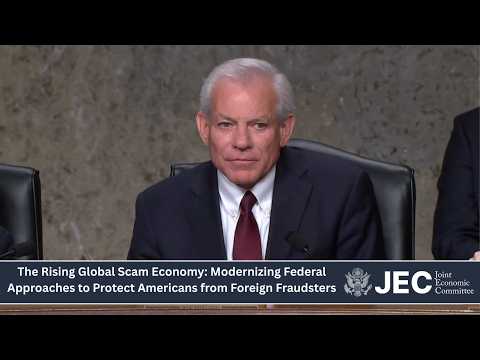
Lawmaker presses panel on stopping overseas 'scam farms'; panelists point to tech, legal and international options
Summary
At a Joint Economic Committee hearing, a lawmaker asked how to prevent U.S. money from funding overseas scam farms and described a 'Mark bill' to authorize private-sector takedowns. Panelists said technology exists but urged layered legal, regulatory and international efforts; Mr. Baker warned the Justice Department would likely be cautious.
A lawmaker pressed a panel at a Joint Economic Committee hearing on how to stop U.S. money from funding overseas "scam farms" that exploit people, asking: "how do I stop my brothers and sisters from being exploited?" The lawmaker described a proposed "Mark bill" they said is rooted in the U.S. Constitution and likened authorized private-sector actors to historical privateers.
Mr. Baker, a panelist, said "it's worth trying" the approach but cautioned that "the Justice Department is not enthusiastic about this. So, they're going to be cautious about using the authority." He also described how scammers shifted attention from Chinese victims to U.S. and European targets and said some countries have used covert action against scam centers.
On possible international responses, Mr. Baker suggested asking whether the United States should encourage regional security actors — including Burmese paramilitaries or the Thai military — with U.S. advisers to take down scam centers, seize evidence and use it against operators. A panelist responded that partnering with regional powers "might be one of the few occasions in life where we could actually partner with some of the regional powers to stop this." The hearing record notes these were proposals raised in discussion, not formal policy decisions.
Panelists repeatedly said there is no single solution. One panelist told the committee, "I have 70 pages of recommendations for you," and urged combining technology deployment with legal and organizational changes. That witness said existing tools — from better identity verification at the point of payment to stronger controls on SIM cards and social-media impersonation — can reduce fraud if the private sector is empowered and regulatory obstacles are addressed.
Miss Stokes said the problem has grown through decades of complacency: "we've allowed this to happen over the last quarter century or more by being complacent," and cautioned against stereotyping victims. Other witnesses urged an organizing principle: define the threat, quantify risks, evaluate current countermeasures, identify gaps and prioritize fixes across technology, statutory reform and organizational change. They warned artificial intelligence and low-cost dark-web tools will make scam operations cheaper and more scalable.
The lawmaker closed by describing the Mark bill as an initial step to "socialize" the constitutional argument for private-sector takedowns, asked panelists to submit documents and letters for the permanent record and formally closed the hearing. No vote or formal decision was recorded on the proposal during this hearing.