Get Full Government Meeting Transcripts, Videos, & Alerts Forever!
Get email alerts on the Redevelopment Toolkit topic
No spam. Unsubscribe anytime.
Mesa staff detail $3 million redevelopment toolkit including demolition grants and vacancy registry
Summary
Mesa staff presented a redevelopment toolkit and proposed a three‑year, $3 million pilot that includes demolition/remediation and code compliance grants, a vacancy registration ordinance, strategic acquisition analysis, public infrastructure funds, and an EDA revolving loan fund; councilmembers pressed staff on demolition cost assumptions, enforcement equity, and program metrics.
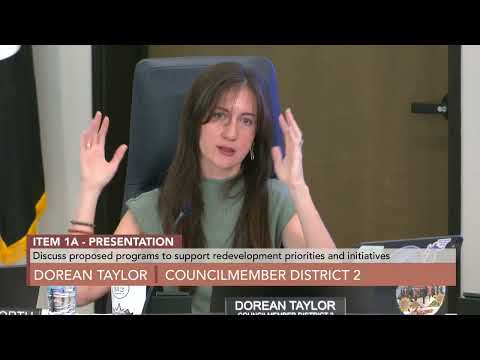
Mesa City Council members on March 26 heard a detailed presentation from city staff on a proposed redevelopment toolkit and a recommended three‑year pilot with an annual general‑fund request of $3 million to support seven programs intended to reduce blight and catalyze private investment.
Staff outlined the toolkit as a menu of tools: a demolition and remediation reimbursement grant (three bids required; maximum award $75,000 as a one‑to‑one match), a $25,000 maximum code compliance revitalization grant for visible storefront and property improvements, a vacancy registration ordinance requiring local contact information and trespass authorization for vacant properties, a strategic acquisition and analysis tool for feasibility work (and rare acquisitions), a public infrastructure rapid‑deployment fund (tiered at $50,000), an EDA revolving loan fund option to fill lending gaps between $50,000 and $250,000, and placemaking/wayfinding investments. Staff said the toolkit is roughly “80%” developed and that final program guidelines, application materials and administration details would be completed with council direction.
Why it matters: staff framed the package as a coordinated approach that pairs smaller, fast‑moving interventions (grants and technical assistance) with the ability to pursue larger, negotiated public‑benefit agreements when projects require more substantial public participation. The pilot is intended to be flexible so staff can shift funding among tools based on market uptake and results.
Council questions focused on program scale and fairness. Multiple councilmembers pressed staff on the $75,000 demolition cap, noting demolition costs vary widely by building type and the presence of hazardous materials; staff said the figure is an initial design‑stage estimate intended to incentivize but not fully subsidize private demolition and that they will return with supporting cost data and market‑sourced estimates. On remediation, staff said the city is pursuing partnerships (including Brownfields and EDA grant carriers) and relying on third‑party partners to administer complex federal grant compliance where appropriate.
The vacancy registration drew sustained debate. Staff proposed that property owners register buildings vacant for 90 days, provide a local contact and opt into Mesa Police Department trespass enforcement; registration would begin free, with escalating renewal fees for continued vacancy (staff proposed a ramp from $150 to $1,000 over successive years) and civil citation fines aligned with commercial civil penalties. Council members raised equity concerns and asked for ownership‑type analysis: staff acknowledged they do not yet have a complete breakdown of vacancy ownership (local owners versus institutional REITs) and agreed to provide that data. Staff said the program was modeled in part on Phoenix’s recent ordinance and that the aim is to reduce staff time locating owners and to connect owners to reuse tools such as the “reuse ready” reimbursements and public infrastructure assistance.
On financing and federal constraints, staff flagged legal limits tied to redevelopment area (RDA) statutes and state gift‑clause interpretations as drivers of conservative award amounts and an expedited administrative path for smaller awards; they also warned that federal programs such as EDA funds have matching and plan requirements (a 40% match and an EDA‑accepted regional plan) that create obstacles and longer lead times.
Next steps and accountability: staff proposed a single intake portal run out of the Office of Urban Transformation, criteria‑based initial screening to reduce red tape, and ongoing performance reporting on metrics such as private capital leveraged, jobs created, tax base effect and number of properties assisted. Council asked for clearer goals tied to the $3 million request and for staff to return with demolition cost benchmarks and an ownership analysis for vacant properties. The presentation closed with staff saying they will treat the first three years as a pilot and report back with outcomes and proposed adjustments.